Home
Class 12
PHYSICS
Four identical charges each .q. are plac...

Four identical charges each .q. are placed at four corners of a square of side .a.. Find the charge to be placed at the centre of the square so that the system of charges is in equilibrium

Text Solution

Verified by Experts
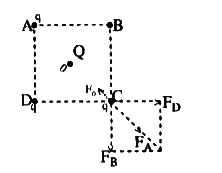

Due to four identical charges kept at four corners of a square, null point (E= 0) is formed at centre O.
Let .Q. be the charge placed at centre of square then the charge .Q. is in equilibrium. For system to be in equilibrium the force on each charge must be zero. Consider the forces on charge at C. Let `F_(A) , F_(B), F_(D) and F_(O)` be the forces on the charge at .C. due to the charges at A, B, D, and .O. respectively
`F_(B) = F_(D) = (1)/(4pi in_(0)) (q^(2))/(a^(2))` Angle between `vec(F)_(B) and vec(F)_(D)" is " 90^(@)`
The magnitude of resultant of `vec(F)_(B) and vec(F)_(D) = sqrt2 xx (1)/(4pi in_(0)) (q^(2))/(a^(2))` The direction of resultant is along AC.
The force `F_(A) = (1)/(4pi in_(0)) (q^(2))/((sqrt2a)^(2)) = (1)/(4pi in_(0)) (q^(2))/(2a^(2))`. It acts along AC. The force on C due to ..Q.. is
`vec(F)_(O) = (1)/(4pi in_(0)) (q^(2))/(((a)/(sqrt2))^(2))= 2 xx (1)/(4pi in_(0))(q^(2))/(a^(2))`
The resultant force on charge at C is zero. `vec(F) = vec(F)_(A) + vec(F)_(B) + vec(F)_(D) + vec(F)_(O) = 0`
`F= (1)/(4pi in_(0))[(q^(2))/(2a^(2)) + sqrt2. (q^(2))/(a^(2)) + (2Qq)/(a^(2))]=0`
`(q)/(a^(2)) [(q)/(2) + sqrt2q + 2Q] = 0 rArr q [(1 + 2 sqrt2)/(2)] + 2Q= 0`
`2Q = -q ((1+ 2 sqrt2)/(2)) rArr Q = (-q)/(4) (2 sqrt2 + 1)`
Negative sign indicates that the forces `vec(F)_(O)` is opposite to the resultant of `vec(F)_(A), vec(F)_(B) and vec(F)_(D)` i.e., along `vec(CO)`
Promotional Banner

Topper's Solved these Questions

  • ELECTRIC CHARGES AND FIELDS

    AAKASH SERIES|Exercise Assess Your Self|13 Videos
  • ELECTRIC CHARGES AND FIELDS

    AAKASH SERIES|Exercise Exercise-I|80 Videos
  • DUAL NATURE OF RADIATION AND MATTER

    AAKASH SERIES|Exercise PRACTICE EXERCISEX|42 Videos
  • ELECTRIC FIELD AND POTENTIAL

    AAKASH SERIES|Exercise PROBLEMS (LEVEL-II)|26 Videos

Similar Questions

Explore conceptually related problems

Four identical point charges q are placed at four corners of a square of side a. Find the potential energy of the charge system. .

Four identical charges q are placed at the corners of a square of side a. Find the potential energy of one of the charges due to the remaining charges. .

A point charge Q is placed at the corner of a square of side a. Find the flux through the square.

Four equal masses (each of mass M) are placed at the corners of a square of side a. The escape velocity of a body from the centre O of the square is

Four identical point charges are placed at the corners of a square, A fifth point charge placed at the center of the square experiences zero net force . Is this a stable equilirium for the fifth charge? Explain.

Four point charges are placed at the corners of a square ABCD of side 10 cm, as shown in figure. The force on a charge of 1muC placed at the centre of square is

Four point charges are placed at the corners of a square of side l. Calculate potential at the centre of square.

Four point charge are placed at the corners of a square with diagonal 2a as shown. What is the total electric field at the center of the squre?

Four positive charges (2sqrt2-1)Q are arranged at the four corners of a square. Another charge q is placed at the centre of the square. Resulting force acting on each corner charge is zero if q is

Three charges, each equal to q, are placed at the three. corners of a square of side a . Find the electric field at. the fourth corner.

AAKASH SERIES-ELECTRIC CHARGES AND FIELDS-Practice Exercise
  1. Four identical charges each .q. are placed at four corners of a square...

    Text Solution

    |

  2. When charge is given to a body

    Text Solution

    |

  3. Calculate force between two charges of 1C each separated by 1m in vacu...

    Text Solution

    |

  4. Two equal and opposite charges are placed at a certain distance apart ...

    Text Solution

    |

  5. Two positively charged small particles, each of mass 1.7 xx 10^(-27) k...

    Text Solution

    |

  6. The minimum electrostatic force between two charged particles placed a...

    Text Solution

    |

  7. The force between two alpha-particles separated by a distance .r. is F...

    Text Solution

    |

  8. The force between two charges 0.06m apart is 5N. If each charge is mov...

    Text Solution

    |

  9. Four point charges qA = 2 µC, qB = –5 µC, qC = 2 µC, and qD = –5 µ C a...

    Text Solution

    |

  10. The force between two charges separated by a distance 1m is 1.8N. The ...

    Text Solution

    |

  11. In 1 gram of solid, there are 5 xx 10^(21) atoms. If one electron is r...

    Text Solution

    |

  12. Two positively charged particles each of mass is 9 xx 10^(-30)kg and c...

    Text Solution

    |

  13. A charge Q is divided into two charge q and Q-q. The value of q such t...

    Text Solution

    |

  14. The ratio of the forces between two charges placed at a certain distan...

    Text Solution

    |

  15. Two point charges +2C and +6C repel each other with a force of 12N. If...

    Text Solution

    |

  16. Two small balls having equal positive charge Q (coulumb) on each suspe...

    Text Solution

    |

  17. The force between two charges 4C and -2C which are separated by a dist...

    Text Solution

    |

  18. Two charges 9 mu C and 1mu C are placed at a distance of 30cm. The pos...

    Text Solution

    |

  19. Three point charges Q(1), Q(2) and Q(3) in that order are placed equal...

    Text Solution

    |

  20. A long solenoid having n = 200 turns per metre has a circular cross-se...

    Text Solution

    |

  21. 10C and 20C are separated by a distance d. If the electric field at th...

    Text Solution

    |

