Home
Class 12
PHYSICS
A ray of light falls normally on a recta...

A ray of light falls normally on a rectangular glass slab.
Draw a ray diagram showing the path of the ray till it emerges out of the slab.

Text Solution

Verified by Experts
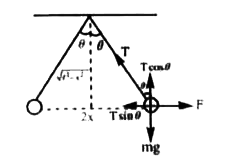

From fig `T cos theta = mg, T sin theta = F`
`(F)/(mg) = tan theta = (x)/(sqrt(1^(2)-x^(2)))` If `theta` is small `Tan theta = sin theta ~~ theta = (x)/(1), (F)/(mg) (x)/(1)`
Where `F= (1)/(4pi in_(0))(q^(2))/(4x^(2)) rArr (q^(2))/(16pi in_(0)x^(2) mg) = (x)/(1)`
`rArr x= ((q^(2)1)/(16pi in_(0)mg))^(1//3)`
`rArr` Tension in the string `T= sqrt(F^(2) + (mg)^(2))`
In the above case if the balls are suspended in a liquid of density `rho` and the distance between the balls remains the same, then
`(F)/(mg) =(F^(1))/(mg^(1)) rArr (F)/(F^(1)) = (mg)/(mg^(1)) rArr (mg)/(mg(1-(rho)/(d)))( because k = (F_(a))/(F_(m)))`
`rArr (1- (rho)/(d)) = (1)/(K) or K = (d)/((d-p))`
(d is density of material of the ball)
`rArr` In the above case if the charges on teh two balls are different and the angles made by those two strings to the vertical are `theta_(1) and theta_(2)` respectively, then `theta_(1) = theta_(2)` (as F, mg are same ) if `m_(1) gt m_(2) " then " theta_(1)lt theta_(2)`
`rArr` In the above application if the whole setup is kept in an artifical satellite (in zero gravity region) the angle between the two strings is `180^(@)` and tension in each string is `(1)/(4pi in_(0))(q^(2))/(41^(2))`
Promotional Banner

Topper's Solved these Questions

  • ELECTRIC CHARGES AND FIELDS

    AAKASH SERIES|Exercise Assess Your Self|13 Videos
  • ELECTRIC CHARGES AND FIELDS

    AAKASH SERIES|Exercise Exercise-I|80 Videos
  • DUAL NATURE OF RADIATION AND MATTER

    AAKASH SERIES|Exercise PRACTICE EXERCISEX|42 Videos
  • ELECTRIC FIELD AND POTENTIAL

    AAKASH SERIES|Exercise PROBLEMS (LEVEL-II)|26 Videos

Similar Questions

Explore conceptually related problems

A ray of light falls normally on a glass slab. Draw a diagram showing the path of the ray till it emerges out of the slab. What is the angle of incidence and angle of refraction at each surface of slab ?

In the adjacent diagram, AO is a ray of light incident on a rectangular glass slab. (a) Complete the path of the ray till it emerges out of the slab. (b) In the diagram, mark the angle of incidence (i) and the angle of refraction (r) at the first interface. how is the refractive index of glass related to the angles i and r ? (c) Mark angle of emergence by the letter e. how are the angles i and e related ? (d) Which two rays are parallel to each other ? Name them (e) Indicate in the diagram the lateral displacement between the emergent ray and the incident ray. state one factor that affects the lateral displacement.

The diagram alongside shows a light source P embedded in a rectangular glass block ABCD of critical angle 42^@ . Complete the path of the ray PQ till it emerges out of the block. [Write necessary angles.]

A ray of light falls on a normally on a refracting face of a prism. Find the angle of prism if the ray just fails to emerge from the prism (mu=3//2).

In the diagram below, PQ is a ray of light incident on a rectangular glass block. Copy the diagram and complete the path of the ray of light through the glass block. In your diagram, mark the angle of incidence by letter 'i' and the angle of emergence by the letter 'e'.

Figure shows two identical prisms P and Q placed with their faces parallel to each other. A light ray AB of yellow colour is incident at the face of the prism P. Complete the diagram to show the path of the ray till it emerges out of the prism Q.

A ray of light enters a glass slab ABCD as shown in figure and strikes at the centre O of the circular parth AC of the slab. The critical angle of glass is 42^(@) . Complete the path of the ray till it emerges out from the slab. mark the angles in the diagram wherever necessary.

Figure below shows two identical prisms A and B placed with their faces parallel to each other. A ray of light of single colour PQ is incident at the face of the prism A. complete the diagram to show the path of the ray till it emerges out of the prism B.

A light ray falls on a rectangular glass slab as shown. The index of refraction of the glass, if total internal reflection is to occur at the vertical face, is

A ray of light is incident normally on a plane glass slab. What will be (i) the angle of refraction, and (ii) the angle of deviation for the ray ?

AAKASH SERIES-ELECTRIC CHARGES AND FIELDS-Practice Exercise
  1. A ray of light falls normally on a rectangular glass slab. Draw a ra...

    Text Solution

    |

  2. When charge is given to a body

    Text Solution

    |

  3. Calculate force between two charges of 1C each separated by 1m in vacu...

    Text Solution

    |

  4. Two equal and opposite charges are placed at a certain distance apart ...

    Text Solution

    |

  5. Two positively charged small particles, each of mass 1.7 xx 10^(-27) k...

    Text Solution

    |

  6. The minimum electrostatic force between two charged particles placed a...

    Text Solution

    |

  7. The force between two alpha-particles separated by a distance .r. is F...

    Text Solution

    |

  8. The force between two charges 0.06m apart is 5N. If each charge is mov...

    Text Solution

    |

  9. Four point charges qA = 2 µC, qB = –5 µC, qC = 2 µC, and qD = –5 µ C a...

    Text Solution

    |

  10. The force between two charges separated by a distance 1m is 1.8N. The ...

    Text Solution

    |

  11. In 1 gram of solid, there are 5 xx 10^(21) atoms. If one electron is r...

    Text Solution

    |

  12. Two positively charged particles each of mass is 9 xx 10^(-30)kg and c...

    Text Solution

    |

  13. A charge Q is divided into two charge q and Q-q. The value of q such t...

    Text Solution

    |

  14. The ratio of the forces between two charges placed at a certain distan...

    Text Solution

    |

  15. Two point charges +2C and +6C repel each other with a force of 12N. If...

    Text Solution

    |

  16. Two small balls having equal positive charge Q (coulumb) on each suspe...

    Text Solution

    |

  17. The force between two charges 4C and -2C which are separated by a dist...

    Text Solution

    |

  18. Two charges 9 mu C and 1mu C are placed at a distance of 30cm. The pos...

    Text Solution

    |

  19. Three point charges Q(1), Q(2) and Q(3) in that order are placed equal...

    Text Solution

    |

  20. A long solenoid having n = 200 turns per metre has a circular cross-se...

    Text Solution

    |

  21. 10C and 20C are separated by a distance d. If the electric field at th...

    Text Solution

    |

