Home
Class 12
PHYSICS
A point mass m and charge q is connected...

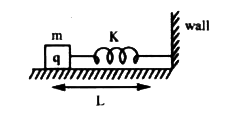
A point mass m and charge q is connected with a spring of negligible mass with natural length L. Initially spring is in its natural length. Now a horizontal uniform electric fiedl E is switched on as shown. Find
(a) the maximum separation between the mass and the wall
(b) Find the separation of the point mass and wall at the equilibrium position of mass.
(c ) FInd the enery stored in the spring at the equilibrium position of the point mass

Text Solution

Verified by Experts

At maximum separation, velocity of point mass is zero. From work energy theorem, `W_("spring") + W_("field") = 0`
`qEx_(0) - (1)/(2) kx_(0)^(2) = 0` (`x_(0)` is maximum elongation)
`rArr x_(0) = (2qE)/(K) therefore` separation `= L + (2qE)/(k)`
(b) At equilibrium position, Eq = `kx rArr x = (qE)/(k) rArr` separation `= L + (qE)/(k)`
(c ) `U = (1)/(2) kx^(2) = (1)/(2) k ((qE)/(k))^(2) = (q^(2)E^(2))/(2k)`
Promotional Banner

Topper's Solved these Questions

  • ELECTRIC CHARGES AND FIELDS

    AAKASH SERIES|Exercise Assess Your Self|13 Videos
  • ELECTRIC CHARGES AND FIELDS

    AAKASH SERIES|Exercise Exercise-I|80 Videos
  • DUAL NATURE OF RADIATION AND MATTER

    AAKASH SERIES|Exercise PRACTICE EXERCISEX|42 Videos
  • ELECTRIC FIELD AND POTENTIAL

    AAKASH SERIES|Exercise PROBLEMS (LEVEL-II)|26 Videos

Similar Questions

Explore conceptually related problems

A block of mass m is attached with a spring in vertical plane as shown in the figure. If initially spring is in its natural length and the block is released from rest, then maximum extension in the spring will be

Find the maximum tension in the spring if initially spring at its natural length when block is released from rest.

Method 3 of W Mass of a piston shown in Fig. is m and area of cross-section is A. Initially spring is in its natural length. Find work done by the gas.

Initialy spring in its natural length now a block at mass 0.25 kg is released then find out maximum force by system on floor ?

Mass m is connected with an ideal spring of natural length l whose other end is fixed on a smooth horizontal table. Initially spring is in its natural length l . Mass m is given a velocity 'v' perpendicular to the spring and released . The velocity perpendicular to the spring when its length l+x , will be

A block of mass m having charge q is attached to a spring of spring constant k . This arrangement is placed in uniform electric field E on smooth horizontal surface as shown in the figure. Initially spring in unstretched. Find the extension of spring in equilibrium position and maximum extension of spring.

The block of mass m is released when the spring was in its natrual length. Spring constant is k. Find the maximum elongation of the spring.

The block of mass m_(1) and m_(2) are connected with a spring of netural length l and spring constant k . The systeam is lying on a smoth horizontal surface. Initially spring is compressed by x_(0) as shown in figure. Show that the two blocks will perform SHM about their equilibrium position. Also (a) find the time period, (b) find amplitude of each block and (c) length of spring as a funcation of time.

A block of mass m having a charge q is placed on a smooth horizontal table and is connected to a wall through an unstressed spring of spring constant k as shown in figure(29.E1) . A horizontal electric field E parallel to the spring is switched on. Find the amplitude of the resulting SHM of the block.

A rod of length l and mass m , pivoted at one end, is held by a spring at its mid - point and a spring at far end. The spring have spring constant k . Find the frequency of small oscillations about the equilibrium position.

AAKASH SERIES-ELECTRIC CHARGES AND FIELDS-Practice Exercise
  1. A point mass m and charge q is connected with a spring of negligible m...

    Text Solution

    |

  2. When charge is given to a body

    Text Solution

    |

  3. Calculate force between two charges of 1C each separated by 1m in vacu...

    Text Solution

    |

  4. Two equal and opposite charges are placed at a certain distance apart ...

    Text Solution

    |

  5. Two positively charged small particles, each of mass 1.7 xx 10^(-27) k...

    Text Solution

    |

  6. The minimum electrostatic force between two charged particles placed a...

    Text Solution

    |

  7. The force between two alpha-particles separated by a distance .r. is F...

    Text Solution

    |

  8. The force between two charges 0.06m apart is 5N. If each charge is mov...

    Text Solution

    |

  9. Four point charges qA = 2 µC, qB = –5 µC, qC = 2 µC, and qD = –5 µ C a...

    Text Solution

    |

  10. The force between two charges separated by a distance 1m is 1.8N. The ...

    Text Solution

    |

  11. In 1 gram of solid, there are 5 xx 10^(21) atoms. If one electron is r...

    Text Solution

    |

  12. Two positively charged particles each of mass is 9 xx 10^(-30)kg and c...

    Text Solution

    |

  13. A charge Q is divided into two charge q and Q-q. The value of q such t...

    Text Solution

    |

  14. The ratio of the forces between two charges placed at a certain distan...

    Text Solution

    |

  15. Two point charges +2C and +6C repel each other with a force of 12N. If...

    Text Solution

    |

  16. Two small balls having equal positive charge Q (coulumb) on each suspe...

    Text Solution

    |

  17. The force between two charges 4C and -2C which are separated by a dist...

    Text Solution

    |

  18. Two charges 9 mu C and 1mu C are placed at a distance of 30cm. The pos...

    Text Solution

    |

  19. Three point charges Q(1), Q(2) and Q(3) in that order are placed equal...

    Text Solution

    |

  20. A long solenoid having n = 200 turns per metre has a circular cross-se...

    Text Solution

    |

  21. 10C and 20C are separated by a distance d. If the electric field at th...

    Text Solution

    |
