Home
Class 12
PHYSICS
A block having charge q mass m is restin...

A block having charge `q` mass m is resting on a smooth horizontal surface at a distance `d` from the wall as shown. Discuss the motion of the block when a uniform electic field E is applied horizontally towards the wall assuming that collision of the block with the wall is completely elastic

Text Solution

Verified by Experts
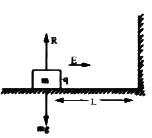
The situation is shown in Fig. Electric force `vec(F)= q vec(E )` will accelerate the block towards the wall producing an acceleration
`a= ( F)/(m) = (qE)/(m) L = (1)/(2) "at"^(2)`
i.e., `t= sqrt((2L)/(a)) = sqrt((2mL)/(qE))`
As collision with the wall is perfectly elastic, the block will rebound with same speed and as now its motion is opposite to the acceleration, it will come to rest after travelling same distance L in same time t. After stopping it will be again accelerated towards the wall and so the block will execute oscillatory motion with .span. L and time period
`T=2t = 2 sqrt((2mL)/(qE))`
However, as the restoring force F(=qE) when the block is moving away from the wall is constant and not proportional to displacement x, the motion is not simple harmonic.
Promotional Banner

Topper's Solved these Questions

  • ELECTRIC CHARGES AND FIELDS

    AAKASH SERIES|Exercise Assess Your Self|13 Videos
  • ELECTRIC CHARGES AND FIELDS

    AAKASH SERIES|Exercise Exercise-I|80 Videos
  • DUAL NATURE OF RADIATION AND MATTER

    AAKASH SERIES|Exercise PRACTICE EXERCISEX|42 Videos
  • ELECTRIC FIELD AND POTENTIAL

    AAKASH SERIES|Exercise PROBLEMS (LEVEL-II)|26 Videos

Similar Questions

Explore conceptually related problems

A block having mass 'm' and charge q is resting on a frictionless plane at distance L from the wall as shown in fig.Discuss the motion of the block when a uniform electric field E is applied horizontally towards the wall assuming that collision of the block with the wall is perfectly elastic.

A block of mass m containing a net positive charge q is placed on a smooth horizontal table which terminates in a vertical wall as shown in figure(29-E2). The distance of the block from the wall is d. A horizontal electric field E to towards right is switched on. Assuming elastic collisions find the time period of the resulting oscillatory motion. Is it a simple harmonic motion?

A force of 50N acts in the direction as shown in figure. The block of mass 5kg, resting on a smooth horizontal surface. Find out the acceleration of the block.

A force of 50N acts in the direction as shown in figure. The block of mass 5kg, resting on a smooth horizontal surface. Find out the acceleration of the block.

A block of mass M is pulled on a smooth horizontal table by a string making an angle theta with the horizontal as shown in figure. If the acceleration of the block is a , find the force applied by the string and by the table N on the block.

A spring block system undergoes SHM on a smooth horizontal surface, the block is now given some charge and a uniform horizontal electric field E is switched on as shown in Fig. As a result

A block of unknown mass is at rest on a rough, horizontal surface. A horizontal force F is applied to the block. The graph in the figure shows the acceleration of the block with respect to the applied force. The mass of the block is

A block of mass m having a charge q is placed on a smooth horizontal table and is connected to a wall through an unstressed spring of spring constant k as shown in figure(29.E1) . A horizontal electric field E parallel to the spring is switched on. Find the amplitude of the resulting SHM of the block.

A block of mass m rests on a stationary wedge of mass M. The wedge can slide freely on a smooth horizontal surface as shown in figure. If the block starts from rest

Figure shows a block of mass 'm' resting on a smooth horizontal surface. It is connected to a rigid wall by a massless spring of stiffness 'k'. The spring is in its natural length. A constant horizontal force F starts acting on the block towards right. Find (i) speed of the block as it moves throught a distance x, (ii) speed when the block is in equlibrium and (iii) maximum extension produced in the speing.

AAKASH SERIES-ELECTRIC CHARGES AND FIELDS-Practice Exercise
  1. A block having charge q mass m is resting on a smooth horizontal surfa...

    Text Solution

    |

  2. When charge is given to a body

    Text Solution

    |

  3. Calculate force between two charges of 1C each separated by 1m in vacu...

    Text Solution

    |

  4. Two equal and opposite charges are placed at a certain distance apart ...

    Text Solution

    |

  5. Two positively charged small particles, each of mass 1.7 xx 10^(-27) k...

    Text Solution

    |

  6. The minimum electrostatic force between two charged particles placed a...

    Text Solution

    |

  7. The force between two alpha-particles separated by a distance .r. is F...

    Text Solution

    |

  8. The force between two charges 0.06m apart is 5N. If each charge is mov...

    Text Solution

    |

  9. Four point charges qA = 2 µC, qB = –5 µC, qC = 2 µC, and qD = –5 µ C a...

    Text Solution

    |

  10. The force between two charges separated by a distance 1m is 1.8N. The ...

    Text Solution

    |

  11. In 1 gram of solid, there are 5 xx 10^(21) atoms. If one electron is r...

    Text Solution

    |

  12. Two positively charged particles each of mass is 9 xx 10^(-30)kg and c...

    Text Solution

    |

  13. A charge Q is divided into two charge q and Q-q. The value of q such t...

    Text Solution

    |

  14. The ratio of the forces between two charges placed at a certain distan...

    Text Solution

    |

  15. Two point charges +2C and +6C repel each other with a force of 12N. If...

    Text Solution

    |

  16. Two small balls having equal positive charge Q (coulumb) on each suspe...

    Text Solution

    |

  17. The force between two charges 4C and -2C which are separated by a dist...

    Text Solution

    |

  18. Two charges 9 mu C and 1mu C are placed at a distance of 30cm. The pos...

    Text Solution

    |

  19. Three point charges Q(1), Q(2) and Q(3) in that order are placed equal...

    Text Solution

    |

  20. A long solenoid having n = 200 turns per metre has a circular cross-se...

    Text Solution

    |

  21. 10C and 20C are separated by a distance d. If the electric field at th...

    Text Solution

    |

