Home
Class 12
PHYSICS
Consider an infinite distribution of poi...

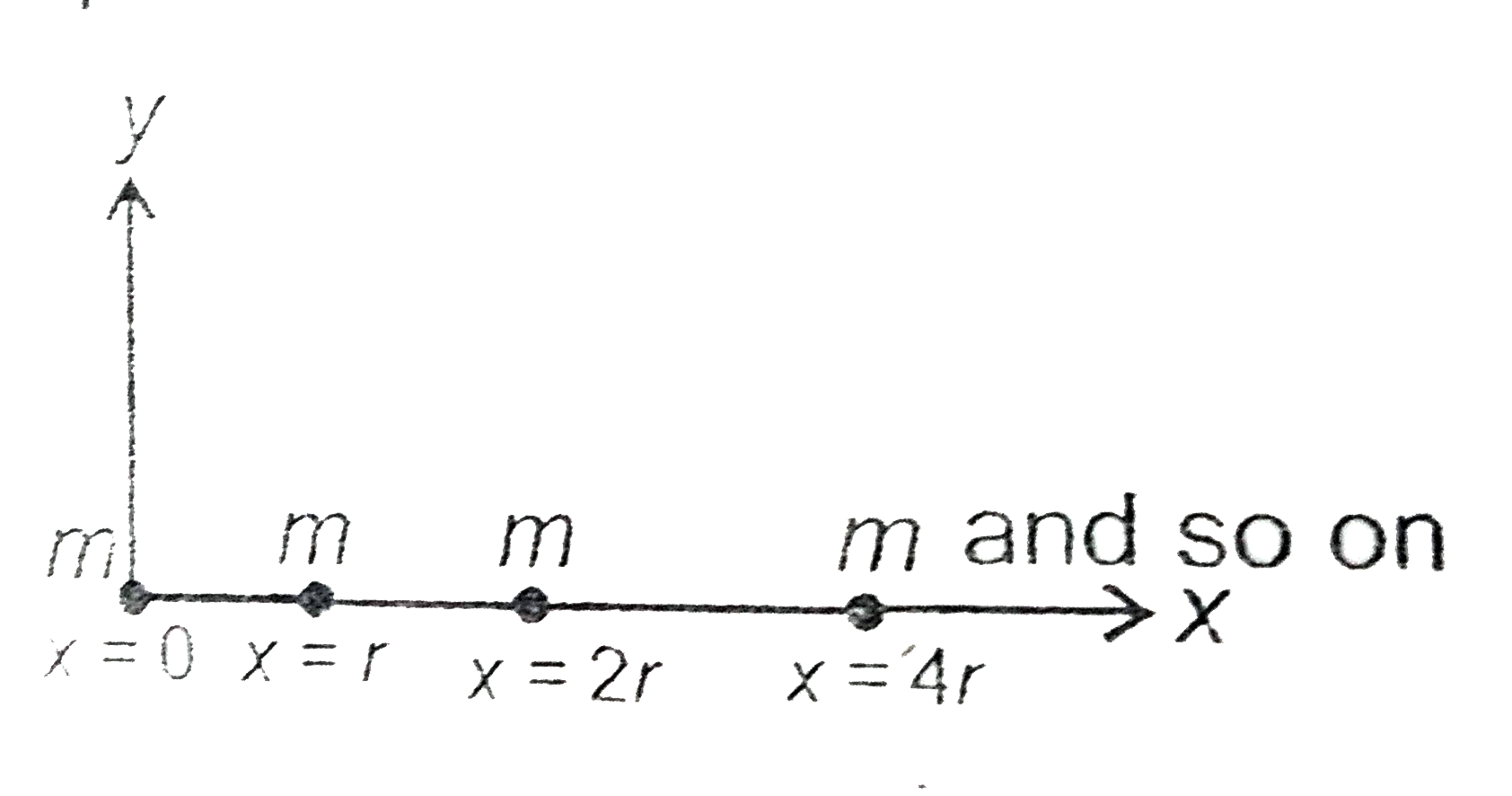
Consider an infinite distribution of point masses (each of mass m) placed on x-axis as shown in the diagram. What is the gravitational force acting on the point mass placed at the origin ?

A

Only a,b are correct

B

Only b,c are correct

C

All are correct

D

All are wrong

Text Solution

Verified by Experts

The correct Answer is:

C
Promotional Banner

Topper's Solved these Questions

  • DUAL NATURE OF RADIATION AND MATTER

    AAKASH SERIES|Exercise EXERCISE-I ASSERTION AND REASON|4 Videos
  • DUAL NATURE OF RADIATION AND MATTER

    AAKASH SERIES|Exercise EXERCISE=II|42 Videos
  • DUAL NATURE OF RADIATION AND MATTER

    AAKASH SERIES|Exercise PRACTICE EXERCISEX|42 Videos
  • CURRENT ELECTRICITY

    AAKASH SERIES|Exercise EXERCISE - IA|2 Videos
  • ELECTRIC CHARGES AND FIELDS

    AAKASH SERIES|Exercise Practice Exercise|57 Videos

Similar Questions

Explore conceptually related problems

Three identical point mass each of mass 1kg lie in the x-y plane at point (0,0), (0,0.2m) and (0.2m, 0). The net gravitational force on the mass at the origin is

Three identical point mass each of mass 1kg lie in the x-y plane at point (0,0), (0,0.2m) and (0.2m, 0). The net gravitational force on the mass at the origin is

A mass m is placed inside a hollow sphere of mass M as shown in figure. The gravitaional force on mass m is

Four point masses each of mass 'm' are placed on the corner of square of side 'a' Calculate magnitude of gravitational force experienced each particle .

Four particles having masses, m, 2m, 3m, and 4m are placed at the four corners of a square of edge a. Find the gravitational force acting on a particle of mass m placed at the center.

Four particles having masses, m, 2m, 3m, and 4m are placed at the four corners of a square of edge a. Find the gravitational force acting on a particle of mass m placed at the centre.

Four particles having masses, m, 2m, 3m, and 4m are placed at the four corners of a square of edge a. Find the gravitational force acting on a particle of mass m placed at the centre.

Three point masses m,m and 2m are placed on the vertex of an equilateral triangle of side 'a' Another point mass 'm' is placed at the centroid of the triangle as shown in the figure. If the magnitude of net force on the point mass placed at centroid is (KGm^2)/(a^2) then find the value of K (G= universal gravitational constant )

We know that when two equal masses are placed on a line then, gravitational force on a third mass is zero due to these two masses when the third is placed at the centre of line joining the two masses. But if third mass is placed anywhere else on the x-axis, the gravitational force acts on that mass due to these two masses. Consider a system shown in figure. In this system two point masses of mass M each are placed at y-axis at a distance a from origin and these masses are fixed. If a third point mass of mass m is released at a distance x from origin on x-axis, then answer the following questions. Which of the following graphs best represents the variation of force on mass m with distance x ?

We know that when two equal masses are placed on a line then, gravitational force on a third mass is zero due to these two masses when the third is placed at the centre of line joining the two masses. But if third mass is placed anywhere else on the x-axis, the gravitational force acts on that mass due to these two masses. Consider a system shown in figure. In this system two point masses of mass M each are placed at y-axis at a distance a from origin and these masses are fixed. If a third point mass of mass m is released at a distance x from origin on x-axis, then answer the following questions. The distance between positions of maximum force on mass m is

AAKASH SERIES-DUAL NATURE OF RADIATION AND MATTER-EXERCISE-I
  1. Assertion : Photoelectric effect supports the quantum nature of light....

    Text Solution

    |

  2. Pick out wrong statement

    Text Solution

    |

  3. Consider an infinite distribution of point masses (each of mass m) pla...

    Text Solution

    |

  4. Statement (A): Every photon striking the metal and colliding with the ...

    Text Solution

    |

  5. The slope of the graph drawn between stopping potential and frequency ...

    Text Solution

    |

  6. The principle of photo cell is

    Text Solution

    |

  7. The correct statement is :

    Text Solution

    |

  8. Flowers are unisexual in :

    Text Solution

    |

  9. A long solenoid having n = 200 turns per metre has a circular cross-se...

    Text Solution

    |

  10. The threshold frequency for a metallic surface corresponds to an energ...

    Text Solution

    |

  11. The mass of electron varies with

    Text Solution

    |

  12. The wavelengths of a photon, an electron and a uranium nucleus are sam...

    Text Solution

    |

  13. The matter waves are

    Text Solution

    |

  14. The wave nature of electron is verified by

    Text Solution

    |

  15. The De- broglie wavelength associated with a matter particle is

    Text Solution

    |

  16. The ratio of wavelength of a photon and that of an electron of same en...

    Text Solution

    |

  17. Enthalpy change of a reaction with be equal to

    Text Solution

    |

  18. Calculate the uncertainty in position of the electron if de-Broglie wa...

    Text Solution

    |

  19. The Phenomena of photoelectric effect and Compton effect will conform

    Text Solution

    |

  20. A solid sphere of radius R/2 is cut out of a solid sphere of radius R ...

    Text Solution

    |
