Home
Class 12
PHYSICS
The graph between deBroglie wavelength (...

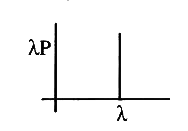
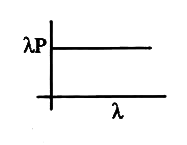
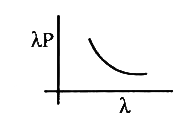
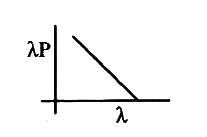
The graph between deBroglie wavelength `(lamda)` and `(lamdap)` is (p is the linear momentum of the particle)

A

B

C

D

Text Solution

Verified by Experts

The correct Answer is:

B
Promotional Banner

Topper's Solved these Questions

  • DUAL NATURE OF RADIATION AND MATTER

    AAKASH SERIES|Exercise EXERCISE=II|42 Videos
  • CURRENT ELECTRICITY

    AAKASH SERIES|Exercise EXERCISE - IA|2 Videos
  • ELECTRIC CHARGES AND FIELDS

    AAKASH SERIES|Exercise Practice Exercise|57 Videos

Similar Questions

Explore conceptually related problems

State how de-Broglie wavelength (lambda) of moving particles varies with their linear momentum (P).

(i) State how de - Broglie wavelength (lambda) of moving particles varies with their linear momentum (p). (ii) State any one phenomenon in which moving particles exhibit wave nature.

The relation between wavelength (lamda) and angular wave number (k) of a wave is

The de-Broglie wavelength L associated with an elementary particle of linear momentum p is bets represented by the graph

de Broglie wavelength of a moving particle is lambda . Its momentum is given by :

Two particles A and B of de-broglie wavelength lambda_(1) and lambda_(2) combine to from a particle C. The process conserves momentum. Find the de-Broglie wavelength of the particle C. (The motion is one dimensional).

Two particles A and B of de-broglie wavelength lambda_(1) and lambda_(2) combine to from a particle C. The process conserves momentum. Find the de-Broglie wavelength of the particle C. (The motion is one dimensional).

Show with the help of a labelled graph how their wavelength (lambda) varies with their linear momentum (p).

Consider the de Broglie wavelength of an electron and a proton. Which wavelength is smaller if the two particles have (a) the same speed (b) the same momentum (c) the same energy?

Electron are accelerated through a potential difference V and protons are accelerated through a potential difference of 4 V. The de-Broglie wavelength are lamda_e and lamda_p for electrons and protons, respectively The ratio of lamda_e/lamda_p is given by ( given , m_e is mass of electron and m_p is mass of proton )

AAKASH SERIES-DUAL NATURE OF RADIATION AND MATTER-PRACTICE EXERCISEX
  1. If the work function for a certain metal is 3.2 xx 10^(-19) J and it ...

    Text Solution

    |

  2. Work function of a metal is 3.0 eV. It is illuminated by a light of wa...

    Text Solution

    |

  3. A metal sheet of silver is exposed to ultraviolet radiation of wavelen...

    Text Solution

    |

  4. The threshold wavelength for emission of photoelectrons from a metal s...

    Text Solution

    |

  5. What will be the minimum frequency of light source to get photocurrent...

    Text Solution

    |

  6. A stationary shell of mass M explodes in to two parts and their masses...

    Text Solution

    |

  7. The graph between deBroglie wavelength (lamda) and (lamdap) is (p is t...

    Text Solution

    |

  8. The de Broglie wavelength of an electron is 1A^(@). In what potential ...

    Text Solution

    |

  9. If the velocity of the particle reduced to one third, then the percent...

    Text Solution

    |

  10. The ratio of the deBroglie wavelengths of proton, deuteron and alpha p...

    Text Solution

    |

  11. Find the momentum of an electron having wavelength 2A^(0)(h=6.62xx10^(...

    Text Solution

    |

  12. Calculate the wavelength (in nanometer) associated with a proton movin...

    Text Solution

    |

  13. <img src="https://d10lpgp6xz60nq.cloudfront.net/physicsimages/BMSDPP01...

    Text Solution

    |

  14. A block of mass m is at rest relative to the stationary wedge of mass ...

    Text Solution

    |

  15. STATEMENT -1 : Work function of a metal depends on ionisation energy....

    Text Solution

    |

  16. With a d.c power supply giving 10mA at a p.d of 50 kV. The power of th...

    Text Solution

    |

  17. Iron (z = 26) emits k(alpha) line of wavelength 1.96A^(@). For an elem...

    Text Solution

    |

  18. Obtain a relation between the frequencies of K(alpha), K(beta) and L(a...

    Text Solution

    |

  19. The energy of a photon is equal to the kinetic energy of a proton. T...

    Text Solution

    |

  20. The radiation corresponding to 3 rarr 2 transition of hydrogen atom fa...

    Text Solution

    |
