Home
Class 12
PHYSICS
Two paralle plane sheets 1 and 2 carry u...

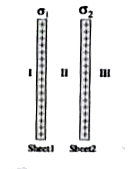
Two paralle plane sheets 1 and 2 carry uniform charge densites `sigma_(1) and sigma_(2)` (see fig. The electric field in the region marked I is (`sigma_(1) gt sigma_(2))`:

A

`-(sigma_(1))/(2epsilon_(0))`

B

`-(sigma_(2))/(2epsilon_(0))`

C

`((sigma_(1)-sigma_(2)))/(2epsilon_(0))`

D

`((sigma_(1)+sigma_(2)))/(2epsilon_(0))`

Text Solution

Verified by Experts

The correct Answer is:

D
Promotional Banner

Topper's Solved these Questions

  • ELECTROSTATICS

    AAKASH SERIES|Exercise LECTURE SHEET (EXERCISE - III) (LEVEL - II (ADVANCED) STRAIGHT OBJECTIVE TYPE QUESTIONS)|5 Videos
  • ELECTROSTATICS

    AAKASH SERIES|Exercise LECTURE SHEET (EXERCISE - III) (LEVEL - II (ADVANCED) MORE THAN ONE CORRECT ANSWER TYPE QUESTIONS)|4 Videos
  • ELECTROSTATICS

    AAKASH SERIES|Exercise LECTURE SHEET (EXERCISE - II) (LEVEL - II (ADVANCED) INTEGER TYPE QUESTIONS)|2 Videos
  • ELECTROMAGNETICS

    AAKASH SERIES|Exercise ADDITIONAL EXERCISE|13 Videos
  • ELEMENTS OF VECTORS

    AAKASH SERIES|Exercise QUESTIONS FOR DESCRIPTIVE ANSWERS|10 Videos

Similar Questions

Explore conceptually related problems

Two thin infinite parallel plates have uniform charge densities + sigma and - sigma . The electric field in the space between them is

Two infinite sheets of unifrom charge density +sigma and -sigma are parallel to each other as shown in the figure. Electric field at the

Two parallel metallic plates have surface charge densities sigma_(1) and sigma_(2) as shown in figure. {:(,"Column-I",,,"Column-II"),((A),"If " sigma_(1)+sigma_(2)=0,,(p),"Electric field in region III is towards right"),((B),"If" sigma_(1)+sigma_(2) gt 0,,(q),"Electric field in region I is zero"),((C),"If "sigma_(1)+sigma_(2) lt 0,,(r),"Electric field in region I is towards roght"),(,,,(s),"Nothing can be said"):}

Two uniformly charged large plane sheets S_1 and S_2 having charge densities sigma_1 and sigma_2 ( sigma_1gtsigma_2 ) are placed at a distance d parallel to each other. A charge q_0 is moved along a line of length a(altd) at an angle 45^@ with the normal to S_1 . Calculate the work done by the electric field

Figure shown two infinitely large conducting plates A and B. If electric field at C due to charge densities sigma_(1), sigma_(2), sigma_(3) and sigma_(40 is E hat(i) , find sigma_(2) and sigma_(3) in terms of E. Derive a relation between sigma_(1) and sigma_(4) .

Three non-conducting large parallel plates have surface charge densities sigma, -2 sigma and 4 sigma respectively as shown in the figure. The electric field at the point P is

Two charged thin infinite plane sheets of uniform surface charge density sigma_(+) and sigma_(-) where |sigma_+| gt|sigma_(-)| , intersect right angle Which of the following best represents the electric field lines for this system:

If three infinite charged sheets of uniform surface charge densities sigma, 2sigma and -4 sigma are placed as shown in figure, then find out electric field intensities at points A, B, C and D.

Two infinitely large sheets having charge densities sigma_(1)andsigma_(2) respectively (sigma_(1)gtsigma_(2)) are placed near each other separated by distance 'd'. A small charge 'q' is placed in between two plates such that there is no effect on charge distribution on plates. Now this charge is moved at an angle of 45^(@) with the horizontal towards plate having charge density sigma_(2) by distance 'a' (altltd) . Find the work done by electric field in the process.

Two unequal blocks placed over each other of densities sigma_(1) and sigma_(2) are immersed in a fluid of density of sigma . The block of density sigma_(1) is fully submerged so that ratio of their masses is 1/2 and sigma//sigma_(1)=2 and sigma//sigma_(2)=0.5 . Find the degree of submergence of the upper block of density sigma_(2) .
