Home
Class 12
PHYSICS
q(1), q(2), q(3) and q(4) are point char...

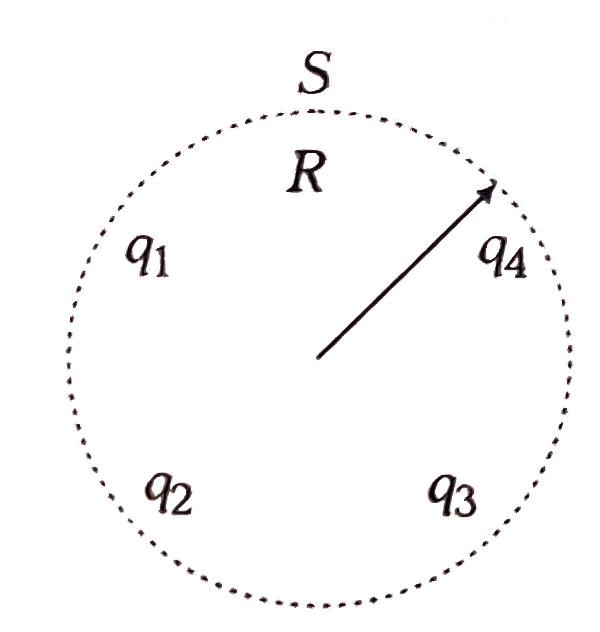
`q_(1), q_(2), q_(3)` and `q_(4)` are point charges located at points as shown in the figure and S is a spherical Gaussian surface of radius R. Which of the following is true according to the Gauss's law ?

A

`oint(vec(E_(1))+vec(E_(2))+vec(E_(3))).dvec(A)=(q_(1)+q_(2)+q_(3))/(epsilon_(0))`

B

`oint(vec(E_(1))+vec(E_(2))+vec(E_(3))+vec(E_(4)))dvec(A)=(q_(1)+q_(2)+q_(3))/(epsilon_(0))`

C

`oint(vec(E_(1))+vec(E_(2))+vec(E_(3))).dvec(A)=((q_(1)+q_(2)+q_(3)+q_(4)))/(epsilon_(0))`

D

`oint(vec(E_(1))+vec(E_(2))+vec(E_(3))+vec(E_(4))).dvecA=((q_(1)+q_(2)+q_(3)+q_(4)))/(epsilon_(0))`

Text Solution

Verified by Experts

The correct Answer is:

B
Promotional Banner

Topper's Solved these Questions

  • ELECTROSTATICS

    AAKASH SERIES|Exercise LECTURE SHEET (EXERCISE - III) (LEVEL - II (ADVANCED) STRAIGHT OBJECTIVE TYPE QUESTIONS)|5 Videos
  • ELECTROSTATICS

    AAKASH SERIES|Exercise LECTURE SHEET (EXERCISE - III) (LEVEL - II (ADVANCED) MORE THAN ONE CORRECT ANSWER TYPE QUESTIONS)|4 Videos
  • ELECTROSTATICS

    AAKASH SERIES|Exercise LECTURE SHEET (EXERCISE - II) (LEVEL - II (ADVANCED) INTEGER TYPE QUESTIONS)|2 Videos
  • ELECTROMAGNETICS

    AAKASH SERIES|Exercise ADDITIONAL EXERCISE|13 Videos
  • ELEMENTS OF VECTORS

    AAKASH SERIES|Exercise QUESTIONS FOR DESCRIPTIVE ANSWERS|10 Videos

Similar Questions

Explore conceptually related problems

q_(1),q_(2),q_(3) and q_(4) are point charges located at point as shown in the figure and s is a spherical Gaussian surface of radius R . Which of the following is true according to the Gauss's law

A point charge +Q is place just outside an imaginary hemispherical surface of radius R as shown in the figure. Which of the following statements is/are correct ?

five charge q_(1),q_(2),q_(3),q_(4) and q_(5) are fixed at their positions as shown in figure . s is Gaussian surface .The Gauss's law is given by ointvec(E).vec(ds)=(q)/(epsilon_(0)) Which of the following statement is correct?

Five charges q_(1),q_(2),q_(3),q_(4)andq_(5) are fixed at their positions as shown in figure. S is Gaussian surface. The Gauss's law is given by ointundersetSvecE*vec(ds)=q/epsilon_(0) . Which of the following statements is correct?

Refer to the arrangement of charges in Fig and a Gaussian surface of radius R with Q at the centre. Then

A charge Q is enclosed by a Gaussian spherical surface of radius R . If the radius is doubled, then the outward electric flux will

Consider a Gaussian spherical surface covering a dipole of charge q and -q, then

A solid insulating sphere of radius a carries a net positive charge 3Q , uniformly distributed throughout its volume. Concentric with this sphere is a conducting spherical shell with inner radius b and outer radius c and having a net charge -Q, as shown in figure a. Consider a spherical Gaussian surface of radius rgtc, the net charge enclosed by this surface is ............. b. The direction of the electric field rgtc is ............. c. The electric field at rgtc is ............... . d. The electric field in the region with radius r, which cgtrgtb, is ............... e. Consider a spherical Gaussian surface of radius r, where cgtrgtb , the net charge enclosed by this surface is ................ . f. Consider a spherical Gaussian surface of radius r, where bgtrgta , the net charge enclosed by this surface is ................. . g. The electric field in the region bgtrgta is ................ . h. Consider a spherical Gaussian surface of radius rlta . Find an expression for the net charge Q(r) enclosed by this surface as a function of r. Note that the charge inside the surface is less than 3Q. i. The electric field in the region rlta is ................. . j. The charge on the inner surface of the conducting shell is .......... . k. The charge on the outer surface of the conducting shell is .............. . l. Make a plot of the magnitude of the electric field versus r.

Consider Gauss's law oint vecE * vecd s = q/epsilon_0 Then, for the situation shown in figure at the Gaussian surface

Three charges -q_(1), +q_(2) and -q_(3) are placed as shown in the figure. The x -component of the force on -q_(1) is proportional to
