Home
Class 12
PHYSICS
An infinite, uniformly charged sheet wit...

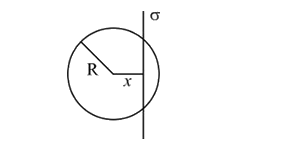
An infinite, uniformly charged sheet with surface charge density cuts through a spherical Gaussian surface of radius R at a distance x from its center, as shown in the figure. The electric flux through the Gaussian surface is :

Text Solution

Verified by Experts

The correct Answer is:

1
Promotional Banner

Topper's Solved these Questions

  • ELECTROSTATICS

    AAKASH SERIES|Exercise LECTURE SHEET (EXERCISE - IV) (LEVEL - I (MAIN) STRAIGHT OBJECTIVE TYPE QUESTIONS)|10 Videos
  • ELECTROSTATICS

    AAKASH SERIES|Exercise LECTURE SHEET (EXERCISE - IV) (LEVEL - II (ADVANCED) STRAIGHT OBJECTIVE TYPE QUESTIONS)|6 Videos
  • ELECTROSTATICS

    AAKASH SERIES|Exercise LECTURE SHEET (EXERCISE - III) (LEVEL - II (ADVANCED) MATRIX MATCHING TYPE QUESTIONS)|1 Videos
  • ELECTROMAGNETICS

    AAKASH SERIES|Exercise ADDITIONAL EXERCISE|13 Videos
  • ELEMENTS OF VECTORS

    AAKASH SERIES|Exercise QUESTIONS FOR DESCRIPTIVE ANSWERS|10 Videos

Similar Questions

Explore conceptually related problems

An infinite, uniformly charged sheet with surface charge density sigma cuts through a spherical Gaussian surface of radius R at a distance X from its center, as shown in the figure. The electric flux Phi through the Gaussian surface is .

The electric flux through the surface

The electric flux through the surface

The electric flux through the surface

Find out flux through the given Gaussian surface.

Which of the following is true for electric-flux through a Gaussian surface ?

A hemispherical surface of radius R is kept in a uniform electric field E as shown in figure. The flux through the curved surface is

A surface encloses an electric dipole. The electric flux through the surface is

A solid of radius 'R' is uniformly charged with charge density rho in its volume. A spherical cavity of radius R/2 is made in the sphere as shown in the figure. Find the electric potential at the centre of the sphere.

A non - conducting disc of radius R is uniformly charged with surface charge density sigma . A disc of radius (R )/(2) is cut from the disc, as shown in the figure. The electric potential at centre C of large disc will be
