Home
Class 12
PHYSICS
A solid metal sphere of radius R has a c...

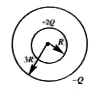
A solid metal sphere of radius R has a charg +2Q. A hollow spherical shell of radius 3R placed concentric with the frist sphere has net charge -Q.

What would be the final distribution of charges if the sphres are joined by a conducting wire

A

`(Q)/(piepsilon_(0)R)`

B

`(Q)/(3piepsilon_(0)R)`

C

`(Q)/(2piepsilon_(0)R)`

D

`(Q)/(7piepsilon_(0)R)`

Text Solution

Verified by Experts

The correct Answer is:

B
Promotional Banner

Topper's Solved these Questions

  • ELECTROSTATICS

    AAKASH SERIES|Exercise LECTURE SHEET (EXERCISE - IV) (LEVEL - II (ADVANCED) STRAIGHT OBJECTIVE TYPE QUESTIONS)|6 Videos
  • ELECTROSTATICS

    AAKASH SERIES|Exercise LECTURE SHEET (EXERCISE - IV) (LEVEL - II (ADVANCED) MORE THAN ONE CORRECT ANSWER TYPE QUESTIONS)|4 Videos
  • ELECTROSTATICS

    AAKASH SERIES|Exercise LECTURE SHEET (EXERCISE - III) (LEVEL - II (ADVANCED) INTEGER TYPE QUESTIONS)|2 Videos
  • ELECTROMAGNETICS

    AAKASH SERIES|Exercise ADDITIONAL EXERCISE|13 Videos
  • ELEMENTS OF VECTORS

    AAKASH SERIES|Exercise QUESTIONS FOR DESCRIPTIVE ANSWERS|10 Videos

Similar Questions

Explore conceptually related problems

A conducting sphere of radius r has a charge . Then .

A solid sphere of radius R has a charge +2Q . A hollow spherical concentric with the first sphere that has net charge -Q. (a) Find the electric field between the spheres at a distance r from the centre of the inner sphere. [R ltr lt3R] (b) Calculate the potential difference between the spheres. (c) What would be the final distribution of charges, if a conducting wire joins the spheres? (d) Instead of (c), if the inner sphere is earthed, what is the charge on it?

A solid conducting sphere of radius a has a net positive charge 2Q . A conducting spherical shell of inner radius b and outer radius c is concentric with the solid sphere and has a net charge -Q . The surface charge density on the inner and outer surfaces of the spherical shell will be

A glass sphere of radius 2R and refractive index n has a spherical cavity of radius R, concentric with it. Q. When viewer is ono left side of the hollow sphere, what will be the shift in position of the object?

A solid metallic sphere of radius a is surrounded by a conducting spherical shell of radius b(bgt a ). The solid sphere is given a charge Q. A student measures the potential at the surface of the solid sphere as V and the potential at the surface of spherical shell as V_b . After taking these readings, he decides . to put charge of -4Q on the shell. He then noted the readings of the potential of solid sphere and the shell and found that the potential difference is /_\V . He then connected the outer spherical shell to the earth by a conducting wire and found that the charge on the outer surface of the shell as He then decides to remove the earthing connection from the shell and earthed the inner solid sphere. Connecting the inner sphere with the earth he observes the charge on the solid sphere as q_2 . He then wanted to check what happens if the two are connected by the conducting wire. So he removed the earthing connection and connected a conducting wire between the solid sphere and the spherical shelll. After the connections were made he found the charge on the outer shell as q_3 . Potential difference (/_\CV) measured by the student between the inner solid shere and outer shell after putting a charge -4Q is

A conducting sphere of radius R is given a charge Q . The electric potential and the electric field at the centre of the sphere respectively are

A conducting sphere of radius R is given a charge Q . The electric potential and the electric field at the centre of the sphere respectively are

Metallic sphere of radius R is charged to potential V. Then charge q is proportional to

A conducting sphere of radius R_(2) has a spherical cavity of radius R_(1) which is non concentric with the sphere. A point charge q_(1) is placed at a distance r from the centre of the cavity. For this arrangement, answer the following questions. If q_(1) is shifted to the centre of the cavity, then: (choose the correct alternative)

A conducting sphere of radius R_(2) has a spherical cavity of radius R_(1) which is non concentric with the sphere. A point charge q_(1) is placed at a distance r from the centre of the cavity. For this arrangement, answer the following questions. Electric potential at the centre of the cavity will be :
