Home
Class 12
PHYSICS
There is a fixed positive charges Q at O...

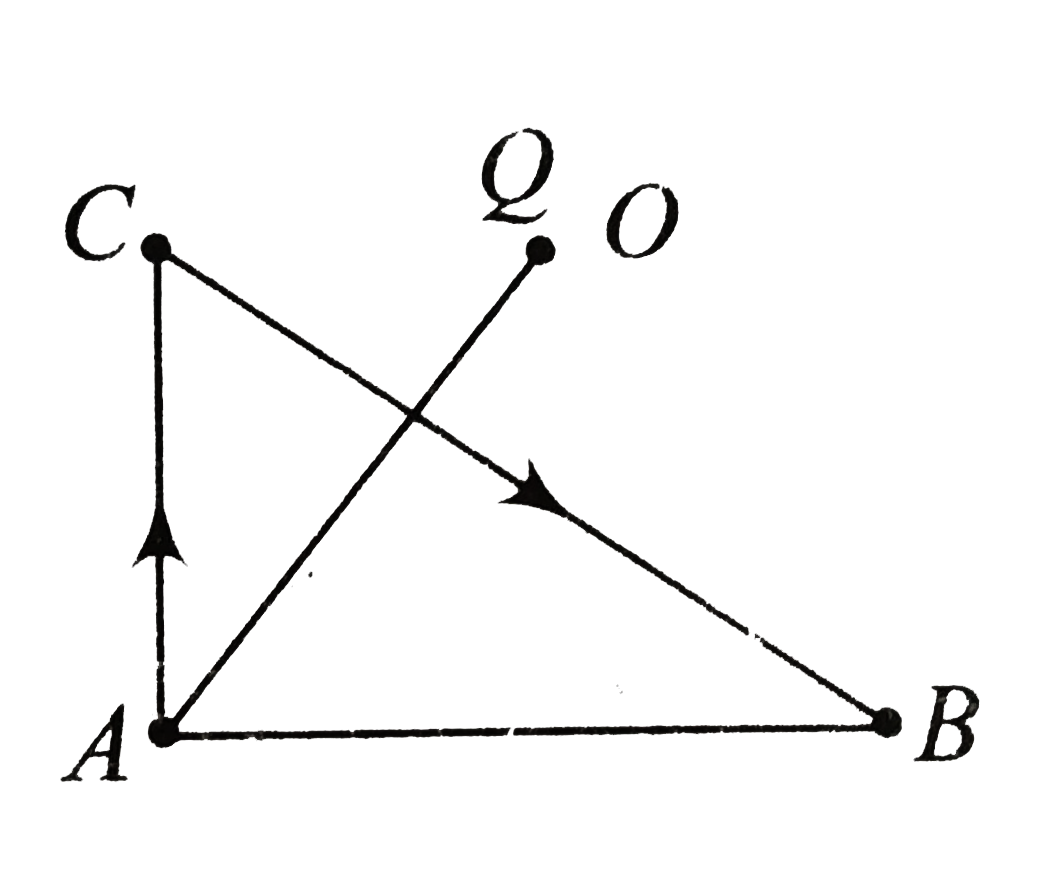
There is a fixed positive charges Q at O, and A and B are points equidistant from O. A positive charge +q is taken slowly by an external agent from A to B along the line AC and then along the line CB.

A

The toal work done on the charge is zero

B

The work done by the electrostatic force from A to C is negative

C

The work done by the electrostatic force from C to B is positive

D

The work done by electrostatic force in taking the charge from A to B is dependent on the actual path followed

Text Solution

Verified by Experts

The correct Answer is:

A, B, C
Promotional Banner

Topper's Solved these Questions

  • ELECTROSTATICS

    AAKASH SERIES|Exercise ADDITIONAL PRACTICE EXERCISE (PRACTICE SHEET (ADVANCED) LINKED COMPPREHENSION TYPE QUESTIONS)|3 Videos
  • ELECTROSTATICS

    AAKASH SERIES|Exercise ADDITIONAL PRACTICE EXERCISE (PRACTICE SHEET (ADVANCED) MATRIX MATCHING TYPE QUESTIONS)|1 Videos
  • ELECTROSTATICS

    AAKASH SERIES|Exercise ADDITIONAL PRACTICE EXERCISE (PRACTICE SHEET (ADVANCED) STRAIGHT OBJECTIVE TYPE QUESTION)|14 Videos
  • ELECTROMAGNETICS

    AAKASH SERIES|Exercise ADDITIONAL EXERCISE|13 Videos
  • ELEMENTS OF VECTORS

    AAKASH SERIES|Exercise QUESTIONS FOR DESCRIPTIVE ANSWERS|10 Videos

Similar Questions

Explore conceptually related problems

The work done in bringing a unit positive charge from infinite distance to a point at distance x from a positive charge Q is W. Then the potential phi at that point is

When a positive q charge is taken from lower potential to a higher potential point, then its potential energy will

When a positive q charge is taken from lower potential to a higher potential point, then its potential energy will

Two charges +Q each are fixed at points C and D. Line AB is the bisector line of CD. A third charge +q is moves from A to B, then from B to C

Two equal positive charges Q are fixed at points (a, 0) and (-a,0) on the x-axis. An opposite charge -q at rest is relased from point (0, a) on the y-axis. The charge -q will

Two identical positive charges are fixed on the y-axis, at equal distances from the origin O. A particle with a negative charges starts on the x-axis at a large distance from O. moves along the x-axis passes through O, and moves far away from O on the other side. Its acceleration a is taken as positive along its direction of motion. Plot acceleration a of the particle against its x-coordinate.

Two fixed, equal, positive charges, each of magnitude 5xx10^-5 coul are located at points A and B separated by a distance of 6m. An equal and opposite charge moves towards them along the line COD, the perpendicular bisector of the line AB. The moving charge, when it reaches the point C at a distance of 4m from O, has a kinetic energy of 4 joules. Calculate the distance of the farthest point D which the negative charge will reach before returning towards C.

Four similar (+q) are placed at origin O, B, C and D as shown. The angles are as shown. Charges at B, C and D are equidistant from O at a distance of a. The forces of repulsion experienced by charge at O due to charges at B and D along CO are equal, given by (q^(2)sqrt(3))/(8piepsilon_(0)a^(2)) . Find the relation between theta_(1), theta_(2) and theta_(3) :

The work done to move a unit charge along an equipotential from P to Q

Two charges each having magnitude q and same polarity are fixed some distance apart.A point charge Q is kept on exactly middle of the line joining the two charges.Then equilibrium of Q is
