Home
Class 12
PHYSICS
A capacitor is formed by two square meta...

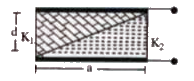
A capacitor is formed by two square metal-plates of edge a, separated by a distance d. Dielectrics of dielectric constants `K_(1) and K_(2)` are filled in the gap as shown in fig. Find the capacitance.

A

`(epsilon_0K_1K_2a^2"ln" (K_1/K_2))/((K_1-K_2)d)`

B

`(epsilon_0(K_1+K_2)a^2"ln" (K_1/K_2))/((K_1-K_2)d)`

C

`(epsilon_0(K_1+K_2)a^2"ln" (K_2/K_1))/((K_1-K_2)d)`

D

`(epsilon_0K_1K_2a^2"ln" (K_2/K_1))/((K_1-K_2)d)`

Text Solution

Verified by Experts

The correct Answer is:

A
Promotional Banner

Topper's Solved these Questions

  • CAPACITORS

    AAKASH SERIES|Exercise LECTURE SHEET (EXERCISE - IV) (LEVEL - II (ADVANCED)) (More than one correct answer Type Questions )|3 Videos
  • CAPACITORS

    AAKASH SERIES|Exercise LECTURE SHEET (EXERCISE - IV) (LEVEL - II (ADVANCED)) (Matrix Matching Type Questions)|1 Videos
  • CAPACITORS

    AAKASH SERIES|Exercise LECTURE SHEET (EXERCISE - IV) (LEVEL - I (MAIN)) Straight Objective Type Questions)|8 Videos
  • ATOMS

    AAKASH SERIES|Exercise PRACTICE EXERCISE|21 Videos
  • COMMUNICATION SYSTEM

    AAKASH SERIES|Exercise LECTURE SHEET (LEVEL - I) (MAIN) (EXERCISE - IV) (Straight Objective & More than one Correct Answer Type Questions)|20 Videos

Similar Questions

Explore conceptually related problems

A capacitor of plate area A and separation d is filled with two dielectrics of dielectric constant K_(1) = 6 and K_(2) = 4 . New capacitance will be

A parallel plate capacitor is formed by two plates, each of area 100 cm^2 , separated by a distance of 1 mm. A dielectric of dielectric constant 5.0 and dielectric strength 1.9 X 10 ^7 Vm^(-1) is filled between the plates. Find the maximum charge that can be stored on the capacitor without causing any dielectric breakdown.

For metals the value of dielectric constant (K) is

A parallel plate capacitor is made of two square plates of side 'a' , separated by a distance d much less than a. The lower triangular portion is filled with a dielectric of dielectric constant K, as shown in the figure. Capacitance of this Capacitor is : a) (Kin_(0)a^(2))/(2d(K+1)) b) (Kin_(0)a^(2))/(d(K-1)) In K c) (Kin_(0)a^(2))/(d)In K d) (1)/(2)(Kin_(0)a^(2))/(d)

In the figure shown P_(2) and P_(2) are two conducting plates having charges of equal magnitude and opposite sign. Two dielectrics of dielectric constant K_(1) and K_(2) fill the space between the plates as shown in the figure. The ratio of electrical energy in 1^("st") dielectric to that in the 2^(nd) dielectric is :

An air capacitor of capacitance C plate area A and plate separation d has been filled with three dielectrics of constant k_(1)=3 , k_(2)=6 and k_(3)=4 as shown in figure . What is the new capacitance ?

Figure shown a parallel-plate capacitor having square plates of edge a and plate-separation d. The gap between the plates is filled with a dielectric of dielectric constant K which varies parallel to an edge as where K and a are constants and x is the distance from the left end. Calculate the capacitance.

Air filled capacitor of capacitance 2 muF is filled with three dielectric material of dielectric constant K_(1) = 4, K _(2) = 4 and K_(3) = 6 as shown in the figure . The new capacitance of the capacitor is

Two identical parallel plate capacitors, of capacitance C each, have plates of area A, separated by a distance d. The space between the plates of the two capacitors, is filled with three dielectrics, of equal thickness and dielectric constants K_(1),K_(2) and K_(3) . The first capacitor is filled as shown in fig. I, and the second one is filled as shown in fig. II. If these two modified capacitors are charged by the same potential V, the ratio of the energy stored in the two, would be ( E_(1) refers to capacitor (I) and E_(2) to capacitor (II)):

Two identical parallel plate capacitors, of capacitance C each, have plates of area A, separated by a distance d. The space between the plates of the two capacitors, is filled with three dielectrics, of equal thickness and dielectric constants K_(1), K_(2) and K_(3) . The first capacitor is filled as shown in fig. I, and the second one is filled as shown in fig. II. If these two modified capacitors are charged by the same potential V, the ratio of the energy stored in the two, would be ( E_(1) refers to capacitor (I) and E_(2) to capacitor (II)):
