Home
Class 12
PHYSICS
A capacitor is to be designed to operate...

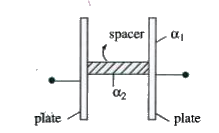
A capacitor is to be designed to operate, with constant capacitance, even when temperature varies.The distance between plates is adjusted by spacer to compensate temperature effect. Let `alpha_(1) and alpha_(2)` be the coefficient of thermal expansion of plate and spacer respectively. Find the ratio of `alpha_2/alpha_1` . So that no change in capacitance of capacitor with change in temperature.

Text Solution

Verified by Experts

The correct Answer is:

2
Promotional Banner

Topper's Solved these Questions

  • CAPACITORS

    AAKASH SERIES|Exercise ADDITIONAL PRACTICE EXERCISE (LEVEL - II LECTURE SHEET (ADVANCED))(Matrix Matching Type Questions)|1 Videos
  • CAPACITORS

    AAKASH SERIES|Exercise ADDITIONAL PRACTICE EXERCISE (LEVEL - II LECTURE SHEET (ADVANCED))(Integer Type Questions )|3 Videos
  • CAPACITORS

    AAKASH SERIES|Exercise ADDITIONAL PRACTICE EXERCISE (LEVEL - I (MAIN)(Straight Objective Type Questions)|22 Videos
  • ATOMS

    AAKASH SERIES|Exercise PRACTICE EXERCISE|21 Videos
  • COMMUNICATION SYSTEM

    AAKASH SERIES|Exercise LECTURE SHEET (LEVEL - I) (MAIN) (EXERCISE - IV) (Straight Objective & More than one Correct Answer Type Questions)|20 Videos

Similar Questions

Explore conceptually related problems

There are two rods of length l_1 and l_2 and coefficient of linear expansions are alpha_1 and alpha_2 respectively. Find equivalent coefficient of thermal expansion for their combination in series.

Two conductors have the same resistance at 0^@C but their temperature coefficient of resistanc are alpha_1 and alpha_2 . The respective temperature coefficients of their series and parallel combinations are nearly

A parallel plate capacitor of area A and separation d is provided with thin insulating spacers to keep its plates aligned in an environment of fluctuating temperature. If the coefficient of thermal expansion of material of the plate is alpha , find the coefficient of thernal expansion (alphas) of the spacers in order that the capacitance does not vary with temperature. (Ignore effect of the spacers on capacitance.)

Two rods of length l_(1) and l_(2) are made of material whose coefficient of linear expansion are alpha_(1) and alpha_(2) , respectively. The difference between their lengths will be independent of temperatiure if l_(1)//l_(2) is to

The variation of volume V, with temperature T, keeping pressure constant is called the coefficient of thermal expansion (alpha) of a gas, i.e., alpha=(1)/(V)((deltaV)/(deltaT))_(P) . For an ideal gas alpha is equal to

Two rods of lengths l_(1) and l_(2) are made of materials having coefficients of linear expansion alpha_(1) and alpha_(2) respectively. What could be the relation between above values, if the difference in the lengths of the two rods does not depends on temperature variation?

Show that moment of inertia of a solid body of any shape changes with temperature as I=I_0(1+2 alphatheta). Where I_0 is the moment of inertia at 0^@C and alpha is the coefficient of linear expansion of the solid.

Two different wires having lengths L_(1) and L_(2) and respective temperature coefficient of linear expansion alpha_(1) and alpha_(2) are joined end - to - end . Then the effective temperature coefficient of linear expansion is :

Two wires of resistance R_(1) and R_(2) have temperature coefficient of resistance alpha_(1) and alpha_(2) respectively. These are joined in series. The effective temperature coefficient of resistance is

Two wires of resistance R_(1) and R_(2) have temperature coefficient of resistance alpha_(1) and alpha_(2) respectively. These are joined in series. The effective temperature coefficient of resistance is
