Home
Class 12
PHYSICS
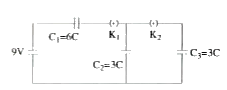
In the ciruit shown in figure, Initially...

In the ciruit shown in figure, Initially `K_1` is closed and `K_2` is open, let charge on capacitor `C_2` is `Q_2` Then `K_1` was opened while `K_2` kept closed, let charge on capacitor `C_2` is `Q_2` (Take, `C=1muF` ) Then ratio `Q_2/Q_1` is

A

`1:1`

B

`2:1`

C

`3:1`

D

`1:3`

Text Solution

Verified by Experts

The correct Answer is:

B
Promotional Banner

Topper's Solved these Questions

  • CAPACITORS

    AAKASH SERIES|Exercise PRACTICE SHEET (ADVANCED) (Linked Comprehension Type Questions Passage)|1 Videos
  • CAPACITORS

    AAKASH SERIES|Exercise PRACTICE SHEET (ADVANCED) (Integer Type Questions)|2 Videos
  • CAPACITORS

    AAKASH SERIES|Exercise ADDITIONAL PRACTICE EXERCISE (LEVEL - II LECTURE SHEET (ADVANCED))(Integer Type Questions )|3 Videos
  • ATOMS

    AAKASH SERIES|Exercise PRACTICE EXERCISE|21 Videos
  • COMMUNICATION SYSTEM

    AAKASH SERIES|Exercise LECTURE SHEET (LEVEL - I) (MAIN) (EXERCISE - IV) (Straight Objective & More than one Correct Answer Type Questions)|20 Videos

Similar Questions

Explore conceptually related problems

In the circuit shown in Fig, initially K_(1) is closed and K_(2) is open . What are the charges on each capacitor. Then K_(1) was opened and K_(2) was closed (order is important). What will be the charge on each capacitor now ? [C = 1muF]

In the circuit shown in figure , initially key K_(1) is closed and key K_(2) is open. Then K_(1) is opened and K_(2) is closed (order is important). [Take Q_(1)^(') and Q_(2)^(') as charges on C_(1) and C_(2) and V_(1) and V_(2) as voltage respectively]. Then

In the circuit shown in figure , initially key K_(1) is closed and key K_(2) is open. Then K_(1) is opened and K_(2) is closed (order is important). [Take Q_(1)^(') and Q_(2)^(') as charges on C_(1) and C_(2) and V_(1) and V_(2) as voltage respectively]. Then

The given R-C circuit has two swithes S_1 and S_2 Swithc S_2 is clsoed and S_1 is open till the capacitor is fully charged to q_0 the S_2 is opened and S_1 is closed simultaneously till the charge on capacitor remains q_0//2 for which it takes time t_1 . Now S_1 is again opened, and S_2 is closed till chrage on capacitor becomes 3q_0/4 . it takes time t_2 (see fig for referecne). Find the raito t_1//t_2

Consider the circuit shown in the figure. (a) Find the current i flowing through the circuit when the key K_(1) is open and K_(2) is closed. (b) Find the net charge on the capacitor when K_(1) is open & K_(2) is.closed and also when K_(1) & K_(2) both are closed. (c) What is the change in the current'i, when K_(1) is closed

In the given circuit switch K is open. The charge on the capacitor is C is steady-state is q_1 Now the key is closed and steady-state charge on C is q_2 The ratio of charges q_1//q_2 is -

Two capacitors C_1 = C and C_2 = 3C are connected as shown in figure, Initially, key K is open and capacitor C_1 holds charge Q. After closing the key K, the charge on each capacitor at steady state will be

In the circuit shown in figure, R(1) = 1Omega, R_(2) = 2Omega, C_(1) = 1 muF, C_(2) = 2 muF and E = 6 V . Calculate charge on each capacitor in steady state

In the circuit shown, all capacitors are identical. Initially, the switch is open and the capacitor marked C_1 is the only one charged to a value Q_0 . After the switch is closed and the equilibrium is reestablished, the charge on the capacitor marked C_1 is Q. Find the ratio initial change to final charge in capacitor C_1 .

In the arrangement shown in figure dielectric constant K_1=2 and K_2=3 . If the capacitance across P and Q are C_1 and C_2 respectively, then C_1//C_2 wil be (the gaps shown are negligible)
