Home
Class 12
PHYSICS
Passage-I : Two large plates are locat...

Passage-I :
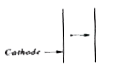
Two large plates are located in vacuum. One of them serves as a cathode, a source of electrons whose initial velocity is negligible. An electron flow directed toward the opposite plate produces a space charge causing the potential in the gap between the plates to vary as `V=ax^(4//3)`, where a is a positive constant, and x is the distance from the cathode.

The current density

A

`-(2)/(3) in_(0)a^(3//2) sqrt((2e)/(m))`

B

`-(4)/(9) in_(0)a^(3//2)sqrt((2e)/(m))`

C

`-(2)/(3)in_(0)a^(3//2)sqrt((2e)/(m))`

D

None.

Text Solution

Verified by Experts

The correct Answer is:

B
Promotional Banner

Topper's Solved these Questions

  • CURRENT ELECTRICITY

    AAKASH SERIES|Exercise PRACTICE SHEET (EXERCISE - I LEVEL-II (ADVANCED) (Matrix Matching Type Questions))|1 Videos
  • CURRENT ELECTRICITY

    AAKASH SERIES|Exercise PRACTICE SHEET (EXERCISE - I LEVEL-II (ADVANCED) (Integer Type Questions))|3 Videos
  • CURRENT ELECTRICITY

    AAKASH SERIES|Exercise PRACTICE SHEET (EXERCISE - I LEVEL-II (ADVANCED) (More than One correct answer Type Questions))|1 Videos
  • CURRENT ELECTRICITY

    AAKASH SERIES|Exercise PROBLEMS (LEVEL-II)|27 Videos
  • DUAL NATURE OF RADIATION AND MATTER

    AAKASH SERIES|Exercise PRACTICE EXERCISEX|42 Videos

Similar Questions

Explore conceptually related problems

Passage-I : Two large plates are located in vacuum. One of them serves as a cathode, a source of electrons whose initial velocity is negligible. An electron flow directed toward the opposite plate produces a space charge causing the potential in the gap between the plates to vary as V=ax^(4//3) , where a is a positive constant, and x is the distance from the cathode. The volume density of sapce charge as a function of x

Passage-I : Two large plates are located in vacuum. One of them serves as a cathode, a source of electrons whose initial velocity is negligible. An electron flow directed toward the opposite plate produces a space charge causing the potential in the gap between the plates to vary as V=ax^(4//3) , where a is a positive constant, and x is the distance from the cathode. The electric field between the plate as a function of x is

Two metallic bodies separated by a distance 20 cm are given equal and opposite charged on magintude 0.88 muC .The component of electric field along the line AB,between the plates, varies as E_(x)=3x^(2)+0.4N//C, where x (in meter) is the distance from one body towards the other body as shown

The potential difference between two large parallel plates is varied as v = at, a is a positive constant and t is time. An electron starts from rest at t=0 from the plate which is at lower potential. If the distance between the plates is L, mass of electron m and charge on electron -e then find the velocity of the electron when it reaches the other plate.

Two parallel plates carry opposites charges such that the electric field in the space between them is in upward direction. An electron is shot in the space and parallel to the plates . Its deflection from the original direction will be

A parallel plate capacitor is made of two circular plates separated by a distance 5mm and with a dielectric of dielectric constant 2.2 between them. When the electric field in the dielectric is 3xx10^4V//m the charge density of the positive plate will be close to:

Answer the following: (i) If two similar large plates, each of area A having surface charge densities +sigma and -sigma are separated by a distance d in air,find the expression for (a) field at points between the two plates and on outer side of the plates. Specify the direction of the field in each case. (b) the potential difference between the plates. (c) the capacitance of the capacitor so formed. (ii) Two metallic spheres of radii R and 2R are charged so that both of these have same surface charge density sigma . If they are connected to each other with a conducting wire, in which direction will the charge flow and why ?

A broad metal plane is connected to earth through a conducting wire as shown. An electron flies with constant velocity along a straight line above the plate at a distance much less than the linear dimensions of the plate. If the current I flowing from the earth to the plate is considered to be positive, then which of the following graph correctly depicts the variation of current I with time ?

When a current through the medium, an electric field exists as well as a potential which varies in space. Suppose that there is a break in a high - voltage transmission line and the free end of a wire of length L is lying on the ground. An electric current flows through the regions of soil adjoining the conductor. If a man happens to be walking near by a potential difference, which is called the step voltage appears between the points where his feet touch the ground, Consequently, an electric current whose strength depends on this potential difference flows through the man. Let us calculate the step voltage. Since the conductor is quite long, we assume that the current flows from it to the ground in a direction perpendicular to the conductor. The equipotential surfaces are the surfaces of semi-cylinders whose axes coincide with the conductor. Suppose that the man is walking in a direction perpendicular to the conductor with a step of length 'b' the distance between the conductor and the foot closer to it being d. Assuming that the current flows uniformly from the conductor over the semi cylindrical region we obtain the following expression for the current density at a distance from the conductor: j=i/(pirL) In this case , the field strength along the radii perpendicular to the conductor is E_r=j/sigma=l/(pirLsigma) Consequently , the step voltage is V_(st)=int_d^(d+b) Edr =1/(pisigmaL)ln((d+b)/d) For example , If l=500A , d=1 m , b=65 cm and L=30 m we find that V_(st) =270 V. Much higher voltages may appear under other conditions and other shapes of conductors. When a part of a high- voltage transmission line falls on the ground, it creates a hazard

The distance between the two plates of a cathode-ray oscilloscope is 1 cm and the potential difference between them is 1200 V. If an electron of energy 2000 eV enters at right angles to the field, what will be its deflection if the plate be 1.5 cm long.
