Home
Class 12
PHYSICS
Passage-II: Consider a block conductin...

Passage-II:
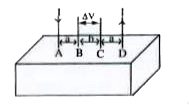
Consider a block conducting material of resistivity .`rho`. shown in the figure. Current .I. enters at .A. and leaves from .D.. We apply superposition principle to find voltage .`DeltaV`. developed between .B. and .C.. The calculation is done in the following steps :
i) Take current .I. entering from .A. and assume it to spread over a hemispherical surface in the block.
ii) Calculate field E(r ) at distance .r. from A by using Ohm.s law `E= rhoj`, where j is the current per unit area at .r..
iii) From the .r. dependence of E(r ), obtain the potential V(r ) at r.
iv) Repeat (i), (ii), (iii) for current .I. leaving .D. and superpose results for .A. and .D..

For current entering at A the electric field at a distance .r. from A is

A

`(rhoI)/(8pi r^(2))`

B

`(rhoI)/(r^(2))`

C

`(rhoI)/(2pir^(2))`

D

`(rhoI)/(4pir^(2))`

Text Solution

Verified by Experts

The correct Answer is:

C
Promotional Banner

Topper's Solved these Questions

  • CURRENT ELECTRICITY

    AAKASH SERIES|Exercise PRACTICE SHEET (EXERCISE - I LEVEL-II (ADVANCED) (Matrix Matching Type Questions))|1 Videos
  • CURRENT ELECTRICITY

    AAKASH SERIES|Exercise PRACTICE SHEET (EXERCISE - I LEVEL-II (ADVANCED) (Integer Type Questions))|3 Videos
  • CURRENT ELECTRICITY

    AAKASH SERIES|Exercise PRACTICE SHEET (EXERCISE - I LEVEL-II (ADVANCED) (More than One correct answer Type Questions))|1 Videos
  • CURRENT ELECTRICITY

    AAKASH SERIES|Exercise PROBLEMS (LEVEL-II)|27 Videos
  • DUAL NATURE OF RADIATION AND MATTER

    AAKASH SERIES|Exercise PRACTICE EXERCISEX|42 Videos

Similar Questions

Explore conceptually related problems

Consider a block of conducting material of resistivity 'rho' shown in the figure. Current 'I' enters at 'A' and leaves from 'D'. We apply superposition principle to find voltage DeltaV developed between 'B' and 'C'. The calculation is done in the following steps: (i) Take current 'I' entering from 'A' and assume it to spread over a hemispherical surface in the block. (ii) Calculate field E(r) at distance 'r' from A by using Ohm's law E = rhoj, where j is the current per unit area at 'r'. (iii) From the 'r' dependence of E(r), obtain the potential V(r) at r. (iv) Repeat (i), (ii) and (iii) for current 'I' leaving 'D' and superpose results for 'A' and 'D'. Delta V measured between B and C is

Consider the circuit shown in the figure. The current I_(3) is equal to

A conducting wire carrying current I is shown in the figure. The magnitude of magnetic field at the point P will be

When some potential differece is maintained between A and B, current I enters the network at A and leaves at B

Assuming all the surfaces to be frictionless accelration of the block c shown in the figure is

A current enters from A and leaves at B through the network shown. Select the correct alternative(s).

Find current (i) in circuit shown in figure.

A current carrying wire is placed in the grooves of an insulating semicircular disc of radius 'R', as shown in Fig. The current enters at point A and leaves from point B. Determine the magnetic field at Point D.

A current carrying wire is placed in the grooves of an insulating semicircular disc of radius 'R', as shown in Fig. The current enters at point A and leaves from point B. Determine the magnetic field at Point D.

A resistance of frustum shape is shown in figure. If a current i passes through the resistance, the electric field at A and B are related as -
