Home
Class 12
PHYSICS
A monochromatic beam of light falls on Y...

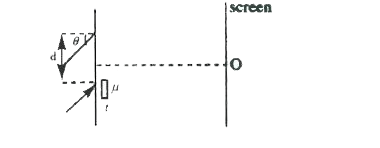
A monochromatic beam of light falls on YDSE apparatus at some angle `(theta)` as shown, a thin sheet of glas (R.I. = `mu`, thickness = t) is insdted in front of the lower slit `S_(2)`. Select the correct alternative.

A

Central maxima will be at O always

B

If `(mu-1) t = d sin theta ` , central maxima will be at O

C

If `(mu-1) t gt d sin theta ` central maxima will be below O

D

If `(mu-1)t = d sin theta +lambda` , a maxima is formed at O

Text Solution

Verified by Experts

The correct Answer is:

B, C, D
Promotional Banner

Topper's Solved these Questions

  • WAVE OPTICS

    AAKASH SERIES|Exercise LECTURE SHEET EXERCISE-I (LEVEL -II) (ADVANCED ) Linked Comprehension Type Questions|7 Videos
  • WAVE OPTICS

    AAKASH SERIES|Exercise LECTURE SHEET EXERCISE-I (LEVEL -II) (ADVANCED ) Matrix Matching Type Questions|2 Videos
  • WAVE OPTICS

    AAKASH SERIES|Exercise LECTURE SHEET EXERCISE-I (LEVEL -II) (ADVANCED )staright Objective Type Questions|30 Videos
  • WAVE MOTION AND SOUND

    AAKASH SERIES|Exercise PROBLEMS (LEVEL - II)|97 Videos
  • WAVES

    AAKASH SERIES|Exercise EXERCISE-III (Doppler effect :)|15 Videos

Similar Questions

Explore conceptually related problems

A monochromatic beam of light fall on YDSE apparatus at some angle (say theta ) as shown in figure. A thin sheet of glass is inserted in front of the lower slit s_(2) . The central bright fringe (path difference = 0 ) will be obtained

A monochromatic beam of light fall on YDSE apparatus at some angle (say theta ) as shown in figure. A thin sheet of glass is inserted in front of the lower slit s_(2) . The central bright fringe (path difference = 0 ) will be obtained

A monochromatic beam of light fall on YDSE apparatus at some angle (say theta ) as shown in figure. A thin sheet of glass is inserted in front of the lower slit s_(2) . The central bright fringe (path difference = 0 ) will be obtained

In a Young's double slit experimental arrangement shown here, if a mica sheet of thickness t and refractive indec mu is placed in front of the slit S_1 , then the path difference (S_1P-S_2P) is

A monochromatic beam of light of 6000 Å is used in YDSE set-up. The two slits are covered with two thin films of equal thickness t but of different refractive indices as shown in figure. Considering the intensity of the incident beam on the slits to be I_(0) , find the point on the screen at which intensity is I_(0) and is just above the central maxima. (Assume that there is no change in intensity of the light after passing through the films.) Consider t = 6 mu m, d = 1 mm, and D = 1 m, where d and D have their usual meaning. Give your answer in mm.

In the YDSE, the monochromatic source of wavelength lambda is placed at a distance d/2 from the central axis (as shown in the figure), where d is the separation between the two slits S_1 and S_2 . (a)Find the position of the central maxima. (b) Find the order of interference formed at O. (c)Now, S is placed on centre dotted line. Find the minimum thickness of the film of refractive indes mu =1.5 to be placed in front of S_2 so that intensity at O becomes 3/4 th of the maximum intensity. (Take lambda=6000Å, d = 6mm .)

Figure shows a YDSE setup having identical slits S_(1) and S_(2) with d =5 mm and D = 1 m. A monochromatic light of wavelength lamda = 6000 Å is incident on the plane of slit due to which at screen centre O, an intensity I_(0) is produced with fringe pattern on both sides Now a thin transparent film of 11 mu m thickness and refractive index mu = 2.1 is placed in front of slit S_(1) and now interference patten is observed again on screen. Due to placement of film in front of S_(1) , how many bright fringes cross the point O of screen excluding the one which was at O earlier :

Figure shows a YDSE setup having identical slits S_(1) and S_(2) with d =5 mm and D = 1 m. A monochromatic light of wavelength lamda = 6000 Å is incident on the plane of slit due to which at screen centre O, an intensity I_(0) is produced with fringe pattern on both sides Now a thin transparent film of 11 mu m thickness and refractive index mu = 2.1 is placed in front of slit S_(1) and now interference patten is observed again on screen. After placing the film of slit S_(1) , the intensity at point O screen is :

Figure shows a YDSE setup having identical slits S_(1) and S_(2) with d =5 mm and D = 1 m. A monochromatic light of wavelength lamda = 6000 Å is incident on the plane of slit due to which at screen centre O, an intensity I_(0) is produced with fringe pattern on both sides Now a thin transparent film of 11 mu m thickness and refractive index mu = 2.1 is placed in front of slit S_(1) and now interference patten is observed again on screen. After placing the film of slit S_(1) , the intensity at point O screen is :

The figure shows a Young's double slit experimental setup. It is observed that when a thin transparent sheet of thickness t and refractive index mu is put front of one of the slits, the central maximum gets shifted by a distance equal to n fringe widths. If the wavelength of light used is lambda , t will be :
