Home
Class 12
PHYSICS
A conducting rod MN moves with a speed v...

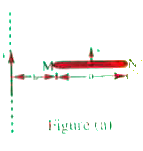
A conducting rod MN moves with a speed v parallel to a long straight wire which carries a constant current i, as shown in Fig. The length of the rod is normal to the wire. Find the emf induced in the total length of the rod. State which end will be at a lower potential.

Text Solution

Verified by Experts
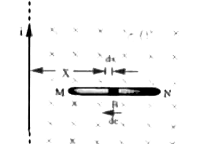
The magnetic field induction due to current i is different at different sections of the rod, because they are at different distances from the wire. Let us, first of all, subdivide the entire length of the conductor MN into elementary sections. Consider a section (shown shaded in the figure (b)) of thickness dx at a distance x from the wire. As all the three, v, B and (dX) are mutually normally to each other, so the emf induced in it is de = Bvdx.
(from N to M by Fleming.s right hand rule)

For the rest of sections, the induced emf is in the same sense, (i.e, from N to M)
` therefore ` Total emf induced in the conductor is
` e = int de = int_b^(b+a) Bvdx`
Substituting for `B = (mu_0 i)/(2pi x)` , the above equation gets changed to
` e = int_b^(b+a) (mu_0 iv dx)/(2pi x)`
` e = (mu_0iv)/(2pi)[ln x]_(b)^(b-a) " or " e = (mu_0 iv)/(2pi) ln (1+alb)`
Promotional Banner

Topper's Solved these Questions

  • ELECTROMAGNETIC INDUCTION

    AAKASH SERIES|Exercise EXERCISE-IA|58 Videos
  • ELECTROMAGNETIC INDUCTION

    AAKASH SERIES|Exercise EXERCISE-IB|18 Videos
  • ELECTRIC FIELD AND POTENTIAL

    AAKASH SERIES|Exercise PROBLEMS (LEVEL-II)|26 Videos
  • ELECTROMAGNETIC WAVES

    AAKASH SERIES|Exercise EXERCISE -II|22 Videos

Similar Questions

Explore conceptually related problems

A copper rod moves with a constant angular velocity omega about a long straight wire carrying a current I. If the ends of the rod from the wire are at distances a and b, then the e.m.f induced in the rod is

A rod of length l is kept parallel to a long wire carrying constant current i . It is moving away from the wire with a velocity v . Find the emf induced in the wire when its distance from the long wire is x .

A thin rod, carrying current i_2 is placed near a long straight wire carrying current i_1 in the plane of rod as shown in figure. The motion of rod is

A rod of length l is kept parallel to a long wire carrying constant current i . It is moving away from the wire with a velocity v. Find the emf induced in the wire when its distance in the wire when its distance from the long wire is x .

Show a conduction loop placed near a long, straight wire carrying current i as shown. If the current increases continuously, find the direction of the induced current in the loop.

A rod of length l is placed perpendicular to a long wire carrying current i . The rod is moved parallel to the wire with a velocity v . Find the emf induced in the rod, if its nearest end is at a distance a from the wire.

A rod of length l is placed perpendicular to a long wire carrying current i . The rod is moved parallel to the wire with a velocity v . Find the emf induced in the rod, if its nearest end is at a distance a from the wire.

The end B of the rod AB which makes angle theta with the floor is being pulled with a constant velocity v_(v) as shown. The length of the rod is l .

A square frame with side a and a long straight wire carrying a current i are located in the same plane as m shown in figure. The fram translates to the right with a constant velocity v . Find the emf induced in the frame as a function of distance x .

Three long, straight and parallel wires are arranged as shown in Fig. The forces experienced by 10 cm length of wire Q is

