Home
Class 12
PHYSICS
A pair of parallel horizontal conducting...

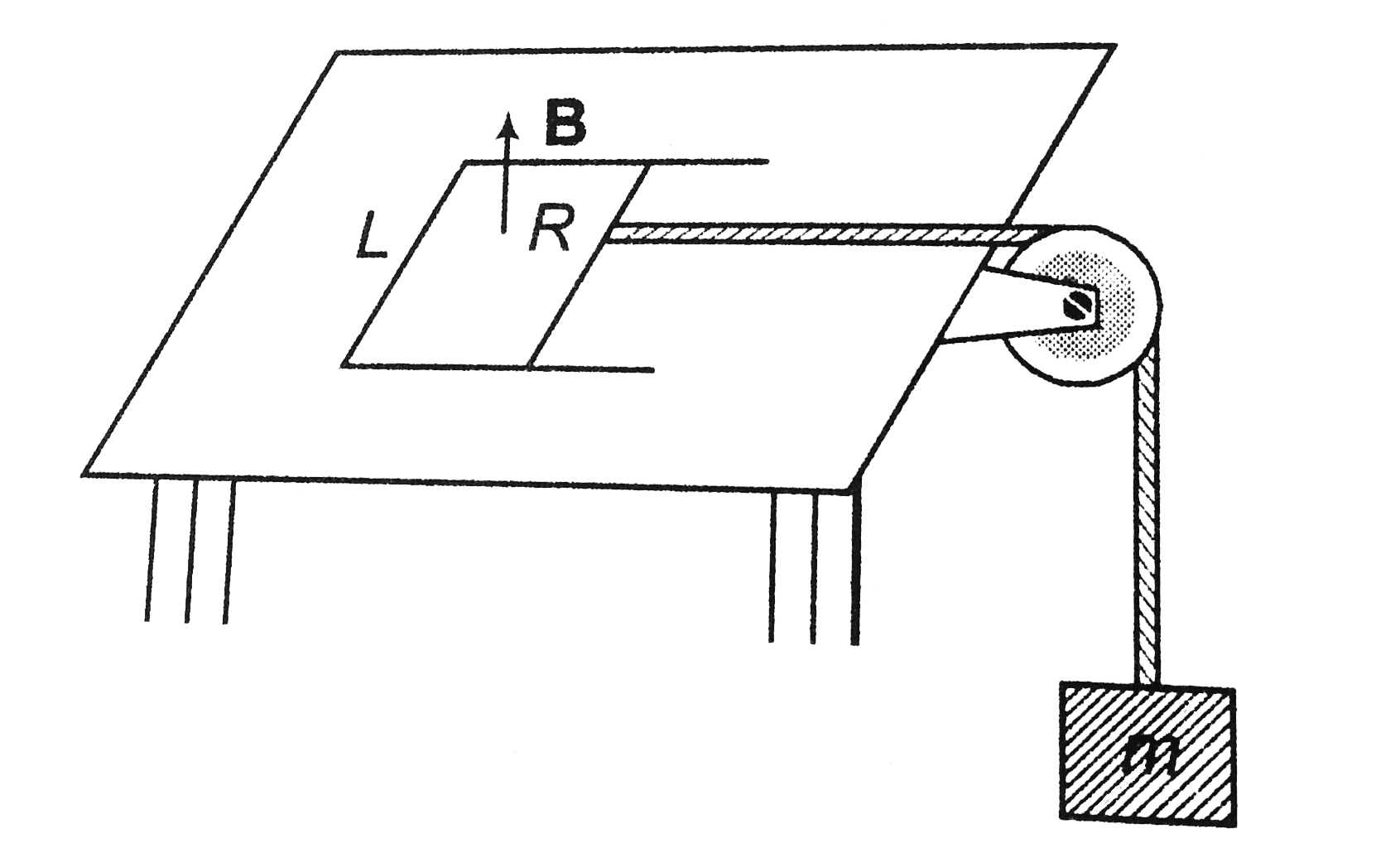
A pair of parallel horizontal conducting rails of negligible resistance shorted at one end is fixed on a table. The distance between the rails is `L`. A conducting massless rod of resistance `R` can slide on the rails frictionlessly. The rod is tied to a massless string which passes over a pulley fixed to the edge of the table. A mass `m` tied to the other end of the string hangs vertically. A constant magnetic field `B` exists perpendicular to the table. If the system is released from rest, calculate

a. the terminal velocity achieved by the rod and
b. The acceleration of the mass of the instant when the velocity of the rod is half the terminal velocity.

Text Solution

Verified by Experts

i) Let the velocity of rod = V
Intensity of magnetic field = B
` therefore ` emf induced in rod (e) = BLV
current induced in rod (i) = `(BLv)/(R )`
Force on the rod F ` = BiL = (B^2 vL^2)/( R)`
Net force on the system = mg - T

mg - T = ma
but `T = F = (B^2 vL^2)/(R ) = ma`
hence `mg - (B^2 v L^2)/( R) =ma`
or `a = g - (B^2 vL^2)/(mR)` ........(i)
For rod to achieve terminal velocity `V_T, a = 0`
` therefore 0 = g - (B^2 v_T L^2)/(mR)`
or Terminal velocity `(v_T) = (mg R)/(B^2 L^2)` .....(ii)
(ii) Acceleration of mass when `v = (v_T)/(2)`
or `v = (mgR)/(2B^2 L^2)` . Put this value of v in (i)
` therefore a = g - (B^2 L^2)/(mR) xx ((mgR)/(2B^2 L^2)) " or " a = g - g/2`
or `a = g/2` .......(iii)
Promotional Banner

Topper's Solved these Questions

  • ELECTROMAGNETIC INDUCTION

    AAKASH SERIES|Exercise EXERCISE-IA|58 Videos
  • ELECTROMAGNETIC INDUCTION

    AAKASH SERIES|Exercise EXERCISE-IB|18 Videos
  • ELECTRIC FIELD AND POTENTIAL

    AAKASH SERIES|Exercise PROBLEMS (LEVEL-II)|26 Videos
  • ELECTROMAGNETIC WAVES

    AAKASH SERIES|Exercise EXERCISE -II|22 Videos

Similar Questions

Explore conceptually related problems

A block of mass m_(1) rests on a horizontal table. A string tied to the block is passed on a frictionless pulley fixed at the end of the table and to the other end of string is hung another block of mass m_(2) . The acceleration of the system is

A block of mass m is tied to a string of length L and the assembly is kept on a smooth horizontal table as shown in the figure. Now the other end of the string is moved with a constant velocity v_(0)hatj . ( xy plane is the plane of the table) Then

Two bodies of masses 4 kg and 6 kg are tied to the ends of a massless string. The string passes over a frictionless pulley. The acceleration of the system is :

Two blocks of masses 6 kg and 4 kg are attached to the two ends of a massless string passing over a smooth fixed pulley. if the system is released, the acceleration of the centre of mass of the system will be

A resistance R is connected between the two ends of the parallel smooth conducting rails.A conducting rod lies on these fixed horizontal rails and a uniform constant magnetic field B exists perpendicular to the plane of the rails as shown in the figure.If the rod is given a velocity v and released as shown in figure, it will stop after some time, which option are correct:

A metallic rod of length 'l' is tied to a string of length 2l and made to rotate with angular speed w on a horizontal table with one end of the string fixed. If there is a vertical magnetic field 'B' in the region, the e.m.f. Induced across the ends of the rod is

Shows a wire sliding on two parallel, conducting rails placed at a separaton l. A magnetic feld B exists in a direction perpendicular to the plane of the rails. What force is necessary to keep the wire moving at a constatn velocity v ?

Figure shows a wire sliding on two parallel, conducting rails placed at a separation L . A magnetic field B exists in a direction perpendicular to the plane of the rails. What force is necessary to keep the wire moving at a constant velocity V ?

A copper rod of mass m slides under gravity on two smooth parallel rails l distance apart set at an angle theta to the horizontal. At the bottom, the rails are joined by a resistance R . There is a uniform magnetic field perpendicular to the plane of the rails. the terminal valocity of the rod is

A rod PQ of mass M and length L is hinged at end P. The rod is kept horizontal by a massless string tied to point Q as shown in figure. When string is cut, the intial angular acceleration of the rod is
