Home
Class 12
PHYSICS
Two parallel vertical metallic bars XX.a...

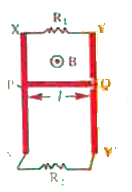
Two parallel vertical metallic bars XX.and YY., of negligible resistance and separated by a length .l., are as shown in Fig. The ends of the bars are joined by resistance `R_(1)` and `R_(2)`. A uniform magnetic field of induction B exists in space normal to the plane of the bars. A horizontal metallic rod PQ of mass m starts falling vertically, making contact with the bars. It is observed that in the steady state the powers dissipated in the resistance `R_(1)` and `R_(2)` are `P_(1)` and `P_(2)` respectively. Find an expression for `R_(1), R_(2)` and the terminal velocity attained by the rod PQ

Text Solution

Verified by Experts
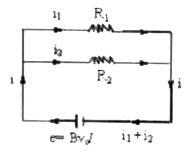
Let `v_0` be the terminal velocity attained by the rod PQ (in the steady state). If `i_1` and `i_2` be the currents flowing through R, and R, in this state, then current flowing through the rod PQ is i= `i_1+i_2` (see the circuit diagram) as shown in Fig.

` therefore ` Applying Kirchoff.s loop rule, yields
`i_1 R_1 = Bv_0 l ` and `i_2 R_2 = Bv_0 l`
` therefore i_1+i_2 = Bv_0 l ((1)/(R_1) + (1)/(R_2)) ` ......(i)
Given that `P_i = i_1^2 R_1 = (B^2 v_0^2 l^2)/(R_1)` .....(ii)
and `P_2 = i_2^2 R_2 = (B^2 v_0^2 l^2)/(R_2)` .....(iii)
Also in the steady state, the acceleration of PQ = 0.
` rArr mg= B (i_1 + i_2 )l`
or `mg = B^2 l^2 v_0 ((1)/(R_1) + (1)/(R_2))` ...(iv)
Multiplying both sides by `v_0` , we get
`mg v_0 = B^2 l^2 v_0^2 ((1)/(R_1) + (1)/(R_2)) = P_1 + P_2`
[From Eq. (ii) and (iii)]
` therefore ` The terminal velocity is `v_0 = (P_1 + P_2)/(mg)`
Substituting for `v_0` in Eq. (ii),
`P_1 = (B^2 l^2)/(R_1) ((P_1 + P_2)/(mg))^2 rArr R_1 = [ (Bl(P_1 + P_2))/(mg)]^2 xx (1)/(P_1)`
Similarly from eq. (iii)
` R_2 = [ (Bl(P_1 + P_2))/(mg)]^2 xx (1)/(P_2)`
Promotional Banner

Topper's Solved these Questions

  • ELECTROMAGNETIC INDUCTION

    AAKASH SERIES|Exercise EXERCISE-IA|58 Videos
  • ELECTROMAGNETIC INDUCTION

    AAKASH SERIES|Exercise EXERCISE-IB|18 Videos
  • ELECTRIC FIELD AND POTENTIAL

    AAKASH SERIES|Exercise PROBLEMS (LEVEL-II)|26 Videos
  • ELECTROMAGNETIC WAVES

    AAKASH SERIES|Exercise EXERCISE -II|22 Videos

Similar Questions

Explore conceptually related problems

Two parallel vertical metallic rails AB and CD are separated by 1m . They are connected at the two ends by resistances R_1 and R_2 as shown in the figure. A horizontal metallic bar l of mass 0.2 kg slides without friction, vertically down the rails under the action of gravity. There is a uniform horizontal magnetic field of 0.6 T perpendicular to the plane of the rails. It is observed that when the terminal velocity is attained, the powers dissipated in R_1 and R_2 are 0.76W and 1.2W respectively (g=9.8m//s^2) The value of R_1 is

Two parallel vertical metallic rails AB and CD are separated by 1m . They are connected at the two ends by resistances R_1 and R_2 as shown in the figure. A horizontal metallic bar l of mass 0.2 kg slides without friction, vertically down the rails under the action of gravity. There is a uniform horizontal magnetic field of 0.6 T perpendicular to the plane of the rails. It is observed that when the terminal velocity is attained, the powers dissipated in R_1 and R_2 are 0.76W and 1.2W respectively (g=9.8m//s^2) The value of R_2 is

Shows a rod of length l and resistance r moving on two rails shorted by a resistance R . A uniform magnetic field B is present normal to the plane of rod and rails. Show the electrical equivalence of each branch.

Shows a rod of length l and resistance r moving on two rails shorted by a resistance R . A uniform magnetic field B is present normal to the plane of rod and rails. Show the electrical equivalence of each branch.

Two parallel vertical metallic rails AB and CD are separated by 1m . They are connected at the two ends by resistances R_1 and R_2 as shown in the figure. A horizontal metallic bar l of mass 0.2 kg slides without friction, vertically down the rails under the action of gravity. There is a uniform horizontal magnetic field of 0.6 T perpendicular to the plane of the rails. It is observed that when the terminal velocity is attained, the powers dissipated in R_1 and R_2 are 0.76W and 1.2W respectively (g=9.8m//s^2) The terminal velocity fo the bar L will be

A copper rod of mass m slides under gravity on two smooth parallel rails l distance apart set at an angle theta to the horizontal. At the bottom, the rails are joined by a resistance R . There is a uniform magnetic field perpendicular to the plane of the rails. the terminal valocity of the rod is

A copper wire ab of length l , resistance r and mass m starts sliding at t=0 down a smooth, vertical, thick pair of connected condcuting rails as shown in figure.A uniform magnetic field B exists in the space in a direction perpendicular to the plane of the rails which options are correct.

a copper rod of mass m slides under gravity on two smooth parallel rails with separation I and set at an angle of theta with the horiziontal at the bottom rails are joined by resistance R. There is a uniform magnetic field B normal to the plane of the rails as shown in the figure The terminal speed of the copper rod is :

Magnetic length of a bar magnet is

A vertical ring of radius r and resistance on R falls vertically. It is in contact with two vertical rails which are joined at the top. The rails are without friction and resistance. There is a horizontal uniform, magnetic field of magnitude B perpendicular to the plane of the ring and the rails. When the speed of the ring is v , the current in the section PQ is

