Home
Class 11
PHYSICS
A bar of mass m and length l is in pure ...

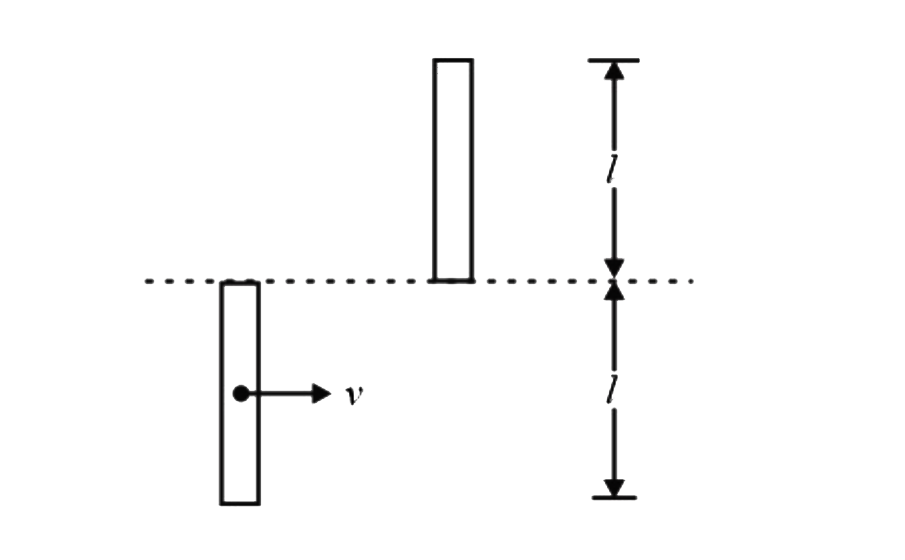
A bar of mass m and length l is in pure translational motion with its centre of mass moving with a velocity v. It collides and sticks to another identical bar at rest as shown in the figure. Assuming that after the collision the system of the two bars becomes one composite bar of length 2l, then the angular velocity of the composite bar will be

A

`(3)/(4)(v)/(l)`, anticlockwise

B

`(4)/(3)(v)/(l)`, anticlockwise

C

`(3)/(4)(v)/(l)`, clockwise

D

`(4)/(3)(v)/(l)`, clockwise

Text Solution

Verified by Experts

The correct Answer is:

A
Promotional Banner

Similar Questions

Explore conceptually related problems

A bar of mass M and length L is in pure traslatory motion with its of mass velocity V . It collides with and sticks to a second identical bar which is initially at rest . ( Assume that it bocomes one composite bar of length 2L) . The angular velocity of the composite bar will be

A body of mass 'm' moving with certain velocity collides with another identical body at rest. If the collision is perfectly elastic and after the collision both the bodies moves

A ball of mass m moving with velocity v collides head on elastically with another identical ball moving with velocity - V. After collision

A ball of mass m moving with velocity v , collide with the wall elastically as shown in the figure. After impact the change in angular momentum about P is : .

A heavy ball of mass 2M moving with a velocity v_(0) collides elastically head on with a cradle of three identical ball each of mass M as shown in figure. Determine the velocity of each ball after collision.

An object of mass m moving with speed u collides one dimentionally with another identical object at rest. Find their velocities after collision, if coefficient of restitution of collision is e.

An object of mass m moving with speed u collides one dimentionally with another identical object at rest. Find their velocities after collision, if coefficient of restitution of collision is e.

A uniform rod of mass m and length L is at rest on a smooth horizontal surface. A ball of mass m, moving with velocity v_0 , hits the rod perpendicularly at its one end and sticks to it. The angular velocity of rod after collision is

A body of mass 4 kg moving with velocity 12 m//s collides with another body of mass 6 kg at rest. If two bodies stick together after collision , then the loss of kinetic energy of system is

A body of mass 4 kg moving with velocity 12 m//s collides with another body of mass 6 kg at rest. If two bodies stick together after collision , then the loss of kinetic energy of system is
