Home
Class 11
PHYSICS
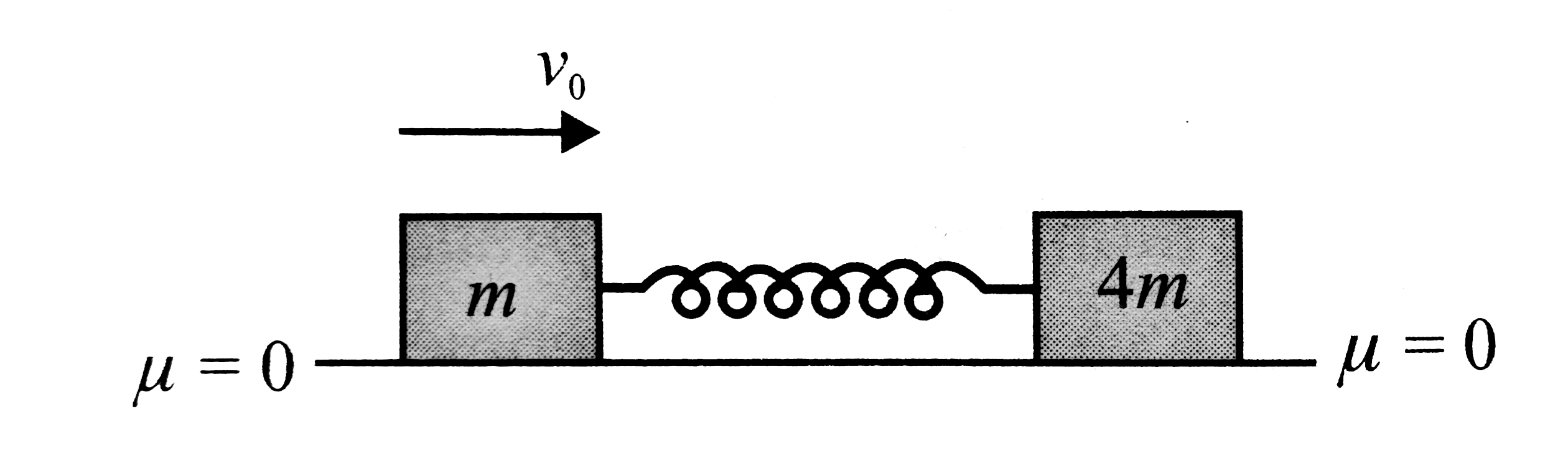
Two blocks of masses in and 4m lie on a ...

Two blocks of masses in and `4m` lie on a smooth horizontal surface connected with a spring in its natural length. Mass `m` is given velocity `v_(0)` through an impulse as shown in Fig. Which of the following is not true about subsequent motion?

A

Kinetic energy is maximum in ground frmae and centre of mass (CM) frmae simultaneously

B

Value of maximum and minimum kinetic energy is same in CM and ground frame

C

Minimum kinetic energy is zero in CM frame but non - zero in ground frame

D

Maximum and mimimum kinetic energy of m in ground frame is respectively `(1)/(2)mv_(0)^(2)` and zero

Text Solution

Verified by Experts

The correct Answer is:

C, D
Promotional Banner

Similar Questions

Explore conceptually related problems

A block of mass m lie on a horizontal smooth surface and connected with the springs at their natural length as shown in figure. When block slightly displaced then find the time period of oscillation.

Two masses m_1 and m_2 are placed on a smooth horizontal surface and are connected by a string of negligible mass. A horizontal force F is applied on the mass m_2 as shown in the figure. The tension in the string is

Mass m is connected with an ideal spring of natural length l whose other end is fixed on a smooth horizontal table. Initially spring is in its natural length l . Mass m is given a velocity 'v' perpendicular to the spring and released . The velocity perpendicular to the spring when its length l+x , will be

A rod AB of mass M and length 8l lies on a smooth horizontal surface. A particle, of mass m and velocity v_(0) strike's the rod perpendicular to its length, as shown in Fig. As a result of the collision, the centre of mass of the rod attains a speed of v_(0)//8 and the particle rebounds back with a speed of v_(0)//4 . Find the following: a. The ratio M//m . b. The angular velocity of the rod about O . c. The coefficient of restitution 'e' for the collision. d. The velocities of the ends 'A' and 'B' of the rod, namely, v_(A) and v_(B) respectively.

A dumbbell consists of two balls A and B of mass m=1 kg and connected by a spring. The whole system is placed on a smooth horizontal surface as shown in the figure. Initially the spring is at its natural length, the ball B is imparted a velocity v_(0)=8/(sqrt(7))m//s in the direction shown. The spring constant of the spring is adjusted so that the length of the spring at maximum elongation is twice that of the natural, length of the spring. Find the maximum potential energy stored (in Joule) in the spring during the motion.

A block of mass m, lying on a smooth horizontal surface, is attached to a spring (of negligible mass) of spring constant k. The other end of the spring is fixed, as shown in the figure. The block is initally at rest in its equilibrium position. If now the block is pulled withe a constant force F, the maximum speed of the block is :

A block of mass m moving with velocity v_(0) on a smooth horizontal surface hits the spring of constant k as shown. The maximum compression in spring is

Two blocks connected by a spring rest on a smooth horizontal plane as shown in Fig. A constant force F start acting on block m_2 as shown in the figure. Which of the following statements are not correct?

Two ring of mass m and 2m are connected with a light spring and can slide over two frictionless parallel horizontal rails as shown in figure. Ring of mass m is given velocity 'v_(0)' in horizontal direction as shown. Calculate the maximum stretch in spring during subsequent motion.

Two blocks A and B of masses in and 2m , respectively, are connected with the help of a spring having spring constant, k as shown in Fig. Initially, both the blocks arc moving with same velocity v on a smooth horizontal plane with the spring in its natural length. During their course of motion, block B makes an inelastic collision with block C of mass m which is initially at rest. The coefficient of restitution for the collision is 1//2 . The maximum compression in the spring is
