Home
Class 11
PHYSICS
An ideal gas is enclosed in a container ...

An ideal gas is enclosed in a container of volume V at a pressure P. It is being pumped out of the container by using a pump with stroke volume V. What is final pressure in container after n-stroke of the pump? (assume temperature remains same)

Text Solution

Verified by Experts
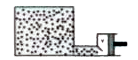
According to ideal gas equation PV = nRT, at constant temperature for a given mass,
`PV=P^(1)V^(1)`
Now as stroke volume is V during 1st stroke for constant mass (say m) volume changes from V to (V + V) and so if pressure changes from P to `P_(1)`, the above equation yields
`PV=P_(1)(V+V),i.e.,P_(1)=P[V/(V+V)]" "...(1)`
After the first stroke, the gas left in the vessel has again volume V but at pressure `P_(1)` (with mass `m_(1)ltm`). Now the second stroke will take place from these initial conditions and if `P_(2)` is the pressure of the gas in the cylinder at the end of 2nd stroke,
`P_(1)V=P_(2)(V+V)`,
i.e., `P_(2)=P_(1)[V/(V+V)]`
Substituting the value of `P_(1)` from equation (1) in the above `P_(2)=P[V/(V+V)]^(2)`
Repeating the same for n strokes, the pressure of the gas in the vessel after `n^(th)` stroke will be,
`P_(n)=P[V/(V+V)]^(n)=P[1/(1+(V//V))]^(n)`.
Promotional Banner

Similar Questions

Explore conceptually related problems

A gas is enclosed in a vessel of volume V at a pressure P . It is being pumped out of the vessel by mean of a piston-pump with a stroke volume. v . What is the final pressure in the vessel after 'n' strokes of the pump ? Assume temperature reamains constant.

A gas is filled in a container of volume V at constant pressure and at 27^(@)C temperature. Find out the amount of gas that will escape out of the container if temperature rises to 37^(@)C

An ideal gas is in a container of volume V_0 at pressure P_0 If the same amount of gas is in container of volume 3V_0 at pressure P_0 . then the ratio of final average translational kinetic energy to the initial average translational kinetic energy of the gaseous molecule is

At pressure P and absolute temperature T a mass M of an ideal gas fills a closed container of volume V. An additional mass 2M of the same gas is added into the container and the volume is then reduced to V/3 and the temperature to T/3 . The pressure of the gas will now be:

Two gases occupy two containers (A) and (B). The gas in (A) of volume 0.11 m^3 experts a pressure of 1.38 Mpa . The gas in (B) of volume 0.16 m^3 experts a pressure of 0.69 Mpa. Two containers are united by a tube of negligible volume and the gases are allowed to intermingle. What is the final pressure in the container if the temperature remains constant ?

Gas is enclosed in a cylinder under S.T.P. conditions. At what temperature does the volume of the enclosed gas become 1/6th of its initial volume, pressure remaining constant ?

An ideal gas of volume V and pressure P expands isothermally to volume 16 V and then compressed adiabatically to volume V . The final pressure of gas is [ gamma = 1.5]

An ideal gas has pressure P, volume V and temperature T. Select the correct option.

Initially a gas of diatomic molecules is contained in a cylinder of volume V_1 at a pressure P_1 and temperature 250 K. Assuming that 25% of the molecules get dissociated causing a change in number of moles. The pressure of the resulting gas, at temperature 2000 K, when contained in a volume 2V_1 is given by P_2 . The ratio P_2//P_1 is ________.

