Home
Class 11
PHYSICS
A rod CD of thermal resistance 5.0KW^(-1...

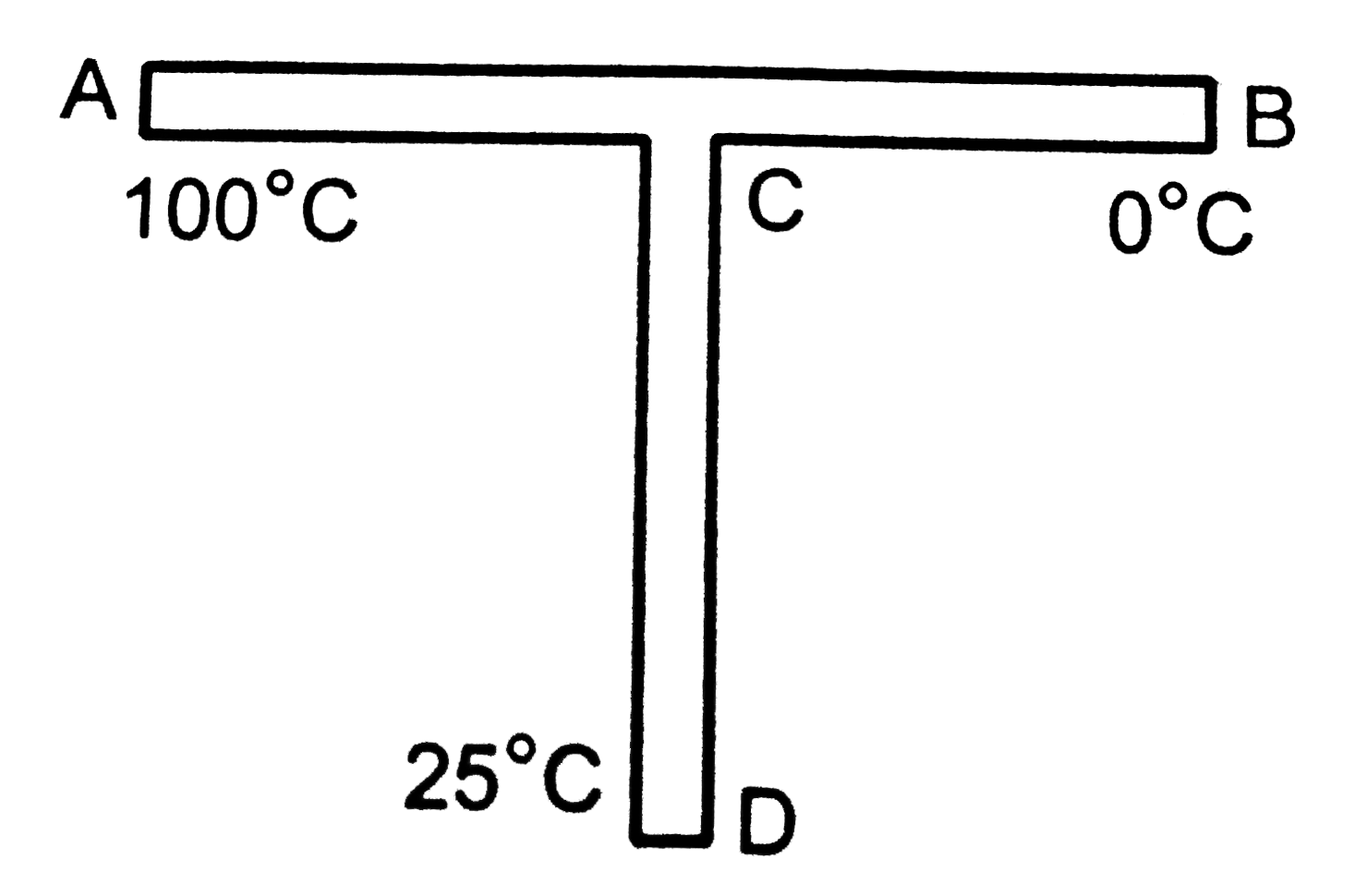
A rod CD of thermal resistance `5.0KW^(-1)` is joined at the middle of an identical rod AB as shown in figure. The ends A, B and D are maintained at `100^(@)C` , `0^(@)C` and `25^(@)C` respectively. Find the heat current in CD.

Text Solution

Verified by Experts

Given, `AC=CB=(CD)/2`
As resistance of the rod is proportional to the length,
so `R_(AC)=R_(CB)=(R_(CD))/2=5/2=2.5K//W`
Let `H_(1)` is the heat current in CD and `H_(2)` in CB, then
`H_(1)=(T_(C)-T_(D))/R_(CD)=(T_(C)-25)/5andH_(2)=(T_(C)-T_(B))/R_(CB)=(T_(C)-0)/2.5`
If H is the heat current through AC, then
`H=(T_(A)-T_(C))/R_(AC)=(100-T_(C))/2.5`
We know that `H=H_(1)+H_(2)`
`therefore(100-T_(C))/2.5=(T_(C)-25)/5+T_(C)/2.5orT_(C)=45^(@)C`
From (i) `H_(1)=(45-25)/5=4.0W`
Promotional Banner

Similar Questions

Explore conceptually related problems

Six identical cunducting rods are joined as shown in Fig. Points A and D are maintained at temperatures 200^@C and 20^@C respectively. The temperature of junction B will be

Six identical cunducting rods are joined as shown in Fig. Points A and D are maintained at temperatures 200^@C and 20^@C respectively. The temperature of junction B will be

Six identical cunducting rods are joined as shown in Fig. Points A and D are maintained at temperatures 200^@C and 20^@C respectively. The temperature of junction B will be

Three identical rods AB , CD and PQ are joined as shown. P and Q are mid points of AB and CD respectively. Ends A , B , C and D are maintained at 0^(@)C , 100^(@)C , 30^(@)C and 60^(@)C respectively. The direction of heat flow in PQ is

Two ends of a conducting rod of varying cross-section are maintained at 200^(@)C and 0^(@)C respectively. In steady state:

Three identical rods AB, CD and PQ are joined as shown. P and Q are mid point of AB and CD respectively. Ends A, B, C and D are maintained at 0^(@)C, 100^(@)C,30^(@)C and 60^(@)C respectively. The direction of heat flow in PQ is

Three rods AB, BC and AC having thermal resistances of 10 units, 10 units and 20 units, respectively, are connected as shown in the figure. Ends A and C are maintained at constant temperatures of 100^@C and 0^@C , respectively. The rate at which the heat is crossing junction B is

Two rods of similar area of cross section and length are joined as shown in the figure. The ratio of their thermal conductivity is 2:3. The free ends are maintained at 100^(@)C and 0^(@)C respectivley. THE temperature at junction in steady state is

In the figure ABC is a conducting rod whose lateral surfaces are insulated. The length of the section AB is one-half of that of BC, and the respective thermal conductivities of the two sections are as given in the figure. If the ends A and C are maintained at 0^(@)C and 70^(@)C respectively, the temperature of junction B in the steady state is

Three conducting rods of same material and cross-section are shown in figure. Temperatures of A,D and C are maintained at 20^(@)C, 90^(@)C and 0^(@)C . The ratio of lengths BD and BC if there is no heat flow in AB is
