Home
Class 11
PHYSICS
One end of a copper rod of uniform cross...


One end of a copper rod of uniform cross section and of length 1.5 m is kept in contact with ice and the other end with water at `100^@C`. At what point along its length should a temperature of `200^@C` be maintained so that in dteady state, the mass of ice melting be equal to that of the steam produced in same interval of time? Assume that the whole system is insulated from surroundings. Latent heat of fusion of ice and vapourization of water are `80 cal//g` and `540 cal//g`, respectively

Text Solution

Verified by Experts
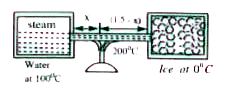

If the point is at a distance x from water at `100^(@)C`,
heat conducted to ice in time t, `Q_("ice")=KA((200-0))/((1.5-x))xxt`
So ice melted by this heat `m_("ice")=Q_("ice")/L_(F)=(KA)/80((200-0))/((1.5-x))xxt`
Similarly heat conducted by the rod to the water at `100^(@)C` in time t,
`Q_("water")=KA((200-100))/xt`
SO steam formed by this heat
`m_("steam")=Q_("water")/L_(v)=KA((200-100))/(540xxx)t`
According to given problem, `m_("ice")=m_("steam"),i.e.`
`200/(80(1.5-x))=100/(540xxx)rArrx=6/58m=10.34cm`
i.e., `200^(@)C` temperature must be maintained at a distance 10.34 cm from water at `100^(@)C`
Promotional Banner

Similar Questions

Explore conceptually related problems

One end of a copper rod of uniform cross section and length 1.5 m is kept in contact with ice and the other end with water at 100^@C . At what point along its length should a temperature of 200^@C be maintained so that in the steady state, the mass of ice melting be equal to that of the steam produced in same interval of time. Assume that the whole system is insulated from surroundings: [L_("ice")=80 cal//g,L_("steam")=540 cal//g]

One end of a copper rod of uniform cross section and length 1.5 m is kept in contact with ice and the other end with water at 100^@C . At what point along its length should a temperature of 200^@C be maintained so that in the steady state, the mass of ice melting be equal to that of the steam produced in same interval of time. Assume that the whole system is insulated from surroundings: [L_("ice")=80 cal//g,L_("steam")=540 cal//g]

One end of a copper rod of uniform cross section and length 1.5 m is kept in contact with ice and the other end with water at 100^@C . At what point along its length should a temperature of 200^@C be maintained so that in the steady state, the mass of ice melting be equal to that of the steam produced in same interval of time. Assume that the whole system is insulated from surroundings: [L_("ice")=80 cal//g,L_("steam")=540 cal//g]

One end of a metal rod is dipped in boiling water and the other is dipped in melting ice.

One end of a brass rod of length 2.0 m and cross section 1cm^2 is kept in steam at 100^@C and the other end in ice at 0^@C . The lateral surface of the rod is covered by heat insulator. Determine the amount of ice melting per minute. Thermal conductivity of brass is 110 W//m-K and specific latent heat of fusion of ice is 80 cal//g .

One end of a steel rod (K=46Js^(-1)m^(-1)C^(-1)) of length 1.0m is kept in ice at 0^(@)C and the other end is kept in boiling water at 100^(@)C . The area of cross section of the rod is 0.04cm^(2) . Assuming no heat loss to the atmosphere, find the mass of the ice melting per second. Latent heat of fusion of ice =3.36xx10^(5)Jkg^(-1) .

Equal masses of ice (at 0^@C) and water are in contact. Find the temperature of water needed to just melt the complete ice.

One end of a copper rod of length 1.0 m and area of cross-section 10^(-3) is immersed in boiling water and the other end in ice. If the coefficient of thermal conductivity of copper is 92 cal//m-s-.^(@)C and the latent heat of ice is 8xx 10^(4) cal//kg , then the amount of ice which will melt in one minute is

Two rods of similar area of cross section and length are joined as shown in the figure. The ratio of their thermal conductivity is 2:3. The free ends are maintained at 100^(@)C and 0^(@)C respectivley. THE temperature at junction in steady state is

A block of ice with a lead shot embedded in it is floating on water contained in a vessel. The temperature of the system is maintained at 0^@C as the ice melts. When the ice melts completely the level of water in the vessel rises.

