Home
Class 11
PHYSICS
The plots of intensity versus wavelength...

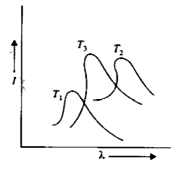
The plots of intensity versus wavelength fro three black bodies at temperatures `T_(1),T_(2)` and `T_(3)` respectively and shown in Fig. 15.11.1. Their temperatures are such that

A

`T_(1)gtT_(2)gtT_(3)`

B

`T_(1)gtT_(3)gtT_(2)`

C

`T_(2)gtT_(3)gtT_(1)`

D

`T_(2)gtT_(3)gtT_(1)`

Text Solution

Verified by Experts

The correct Answer is:

B
Promotional Banner

Similar Questions

Explore conceptually related problems

The plots of intensity versus wavelength for three black bodies at temperatures T_(1),T_(2) and T_(3) respectively are shown in Their temperatures are shown in How their temperatures are related ? .

The plots of intensity versus wavelength for three black bodies at temperature T_1,T_2 and T_3 respectively are as shown. Their temperatures are such that

Three isothermal plots (P versus V) A, B and C are plotted at three temperature T_(1), T_(2) and T_(3) respectively The correct order of the temperature will be

The isothermal diagram of a gas at three different temperatures T_(1),T_(2) and T_(3) , is show in the given figure .Then

Figure shows graphs of pressure versus density for an ideal gas at two temperatures T_(1) and T_(2) Which is correct ? .

The plot of In k versus 1/T is liner with slope of

x_1 and x_2 are susceptibility of a Paramagnetic material at temperatures T_1, K and T_2K respectively, then

Four thin identical rods AB, AC, BD and EF made of the same material are joined as shown. The free-ends C,D and F are maintained at temperature T_(1),T_(2) and T_(3) respectively. Assuming that there is no loss of heat of the surroundings, the temperature at joint E when the steady state is attained is (1)/(K) (2T_(1)+2T_(2)+3T_(3)) . Find K (E is mid point of AB)

The V - i graph for a conductor at temperature T_(1) and T_(2) are as shown in the figure. ( T_(2) - T_(1)) is proportional to

Four identical rods AB, CD, CF and DE are joined as shown in figure. The length, cross-sectional area and thermal conductivity of each rod are l, A and K respectively. The ends A, E and F are maintained at temperature T_(1) , T_(2) and T_(3) respectively. Assuming no loss of heat to the atmosphere, find the temperature at B.
