Home
Class 11
PHYSICS
A particle (a mud pallet, say) of mass m...

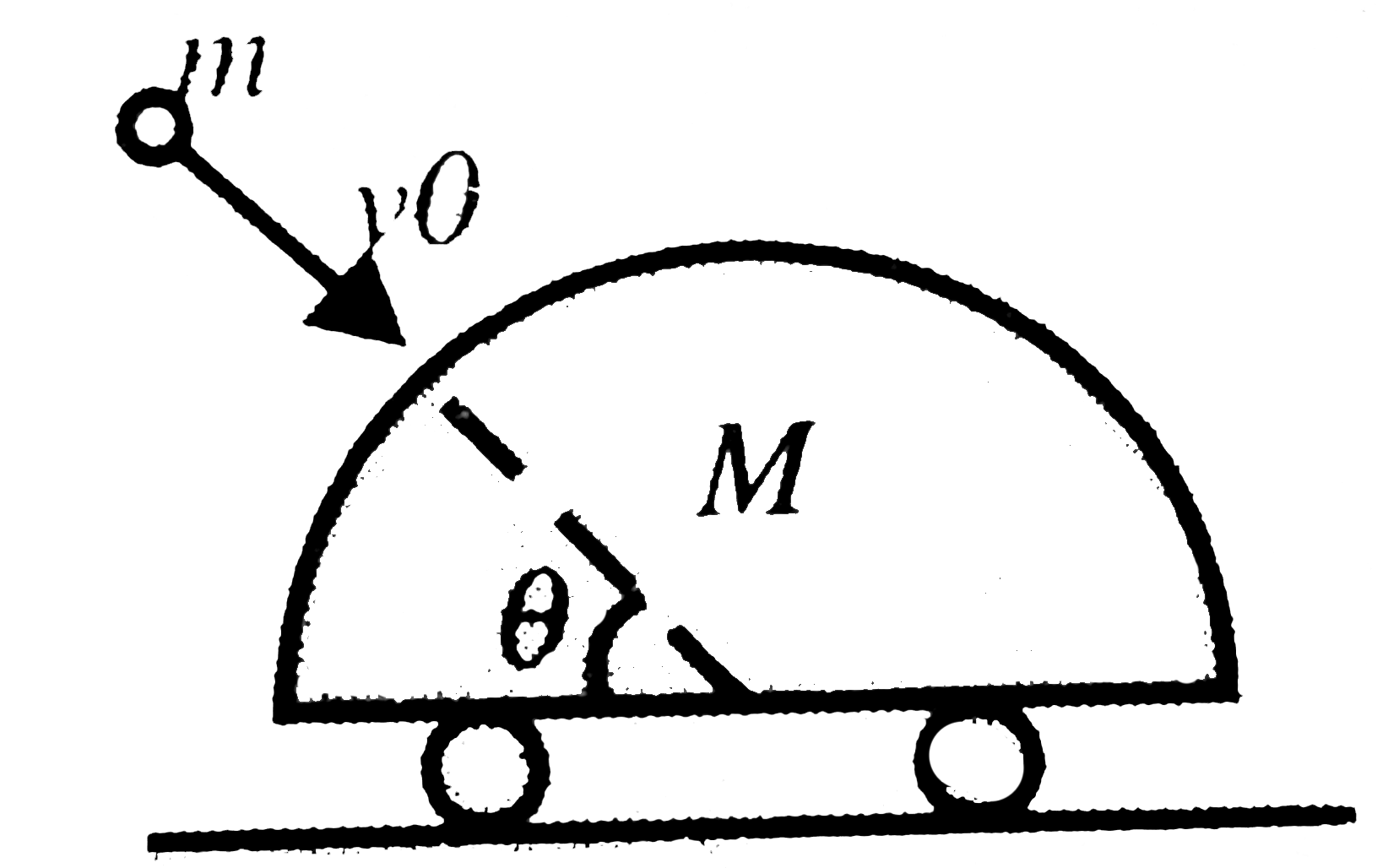
A particle (a mud pallet, say) of mass `m` strikes a smooth stationary wedge of mass `M` with as velocity `v_(0)` at an angle `theta` with horizontal. If the collision is perfectly inelastic, find the
a. velocity of the wedge just after the collision.
b. Change in `KE` of the system `(M+m)` in collision.

Text Solution

Verified by Experts
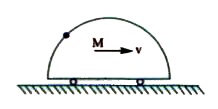
(a) Let the system (M +m) move as a single mass with a velocity v.
Conserving the momentum of the system horizontally , we have `mv _(0) cos theta = (M+m) v`
This gives `v = (mv _(0) cos theta)/( M +m)`
(b) The change in KE of the system is
`Delta K = 1/2 (M +m) v ^(2) - 1/2 mv _(0) ^(2) ` where `v = (mv _(0) cos theta)/( M +m)`
This gives `Delta K = ((M+m))/( 2) (( mv _(0) cos theta ) /(M + m )) ^(2) -1/2 mv _(0) ^(2)`
`=- ( mv _(0) ^(2))/( 2) (1- (m)/( M + m ) cos ^(2) theta ) = - ((M + m sin ^(2) theta) mv _(0) ^(2))/( 2 (M + m ))`
Promotional Banner

Similar Questions

Explore conceptually related problems

A particle of mass m strikes a disc of radius R and mass m with a speed u as shown in the figure. What is the speed of the particle just after the collision if the collision is perfectly inelastic ?

A body of mass 'm' moving with certain velocity collides with another identical body at rest. If the collision is perfectly elastic and after the collision both the bodies moves

A point mass m collides with a disc of mass m and radius R resting on a rough horizontal surface as shown . Its collision is perfectly elastic. Find angular velocity of the disc after pure rolling starts

Two balls of equal masses m each undergo oblique collision. If colision is perfectly elastic, then angle between their velocities after collision is

A body of mass 10 kg and velocity 10 m/s collides with a stationary body of mass 5 kg . After collision both bodies stick to each other , velocity of the bodies after collision will be

Two balls of masses m each are moving at right angle to each other with velocities 6 m/s and 8 m/s respectively. If collision between them is perfectly inelastic, the velocity of combined mass is

A body of mass m is dropped from a height of h . Simultaneously another body of mass 2m is thrown up vertically with such a velocity v that they collide at height h/2 . If the collision is perfectly inelastic, the velocity of combined mass at the time of collision with the ground will be

A body of mass m is dropped from a height of h . Simultaneously another body of mass 2m is thrown up vertically with such a velocity v that they collide at height h/2 . If the collision is perfectly inelastic, the velocity of combined mass at the time of collision with the ground will be

A ball of mass m is dropped onto a smooth fixed wedge of inclination theta The collision is perfectly elastic . If after the collision, the x component of the velocity of the block is sqrt(2 gh) , then theta is

A rigid uniform rod of mass M and length L is placed along the Y-axis on a smooth horizontal surface with its centre at the origin. Two particles , each of mas m ( = M //12) hits simultaneously , at the two ends with equal speed v as shown in the figure. The collision is completely inelastic. (i) Find the angular velocity of the system after the collision. (ii) Two particles of mass 2m and m are placed respectively at ( L//2, 0) and ( - L//2, 0) . Calculate the time when the rod hits these particles.

