Home
Class 11
PHYSICS
Two blocks A and B of masses m and 2m re...

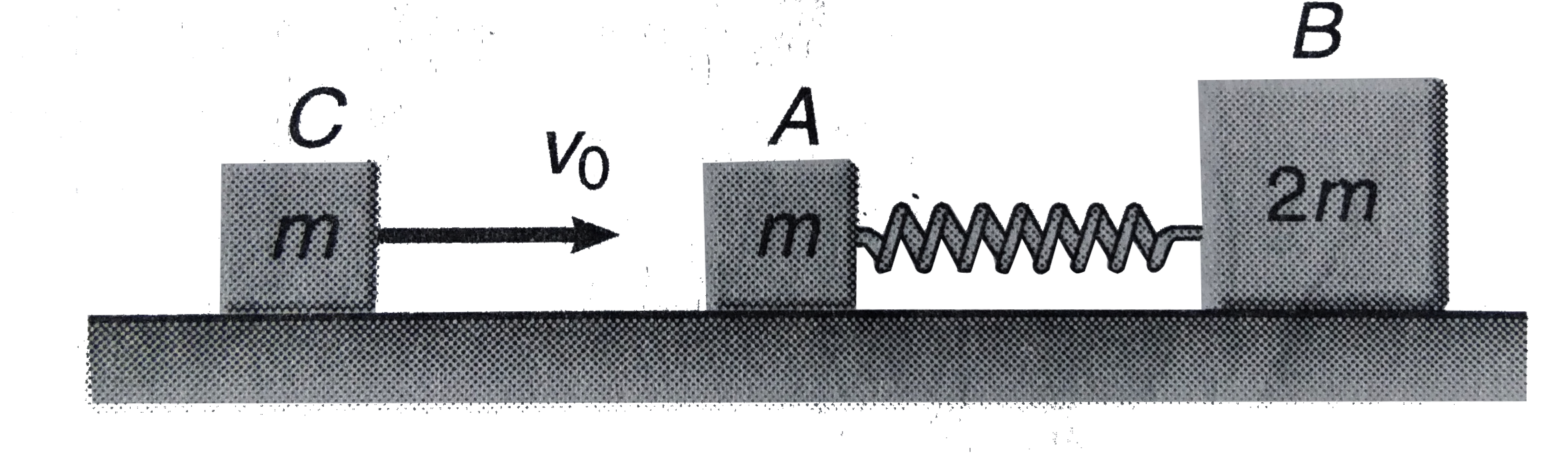
Two blocks A and B of masses m and 2m respectively are placed on a smooth floor. They are connected by a spring. A third block C of mass m moves with a velocity `v_0` along the line joing A and B and collides elastically with A, as shown in figure. At a certain instant of time `t_0` after collision, it is found that the instantaneous velocities of A and B are the same. Further, at this instant the compression of the spring is found to be `x_0`. Determine (i) the common velocity of A and B at time `t_0`, and (ii) the spring constant.

Text Solution

Verified by Experts

The correct Answer is:

`(v_(0))/(3), (2)/(3) (mv _(0) ^(2))/( x _(0) ^(2))`
Promotional Banner

Similar Questions

Explore conceptually related problems

Two blocks A and B of masses in and 2m respectively placed on a smooth floor are connected by a spring. A third body C of mass m moves with velocity v_(0) along the line joining A and B and collides elastically with A . At a certain instant of time after collision it is found that the instantaneous velocities of A and B are same then:

Two bodies A and B of masses m and 2m respectively are placed on a smooth floor. They are connected by a light spring of stiffness k. A third body C of mass m moves with velocity v_(0) along the line joining A and B and collides elastically with A. If l_(o) be the natural length of the spring then find the minimum separation between the blocks.

A ball A of mass M collides elastically with a similar ball B at rest as shown in figure. Initially velocity of ball A is u m/s. After collision,

A body of mass m/2 moving with velocity v_0 collides elastically with another mass of m/3 . Find % change in KE of first body

A heavy ball of mass 2M moving with a velocity v_(0) collides elastically head on with a cradle of three identical ball each of mass M as shown in figure. Determine the velocity of each ball after collision.

A block C of mass m is moving with velocity v_(0) and collides elastically with block A of mass m and connected to another block B of mass 2m through spring constant k. What is k if x_(0) is compression of spring when velocity of A and B is same?

A block of mass m moving with velocity v_(0) on a smooth horizontal surface hits the spring of constant k as shown. The maximum compression in spring is

Two identical blocks A and B , each of mass m resting on smooth floor are connected by a light spring of natural length L and spring constant k , with the spring at its natural length. A third identical block C (mass m ) moving with a speed v along the line joining A and B collides with A . The maximum compression in the spring is

Two blocks A and B of mass 2m and m respectively are connected to a massless spring of force constant K as shown in figure A and B are moving on the horizontal frcitionless surface with velocity v to right with underformed spring. If B collides with C elastically, then maximum compression of the spring will be

Two blocks A and B of masses m and 2m , respectively are connected by a spring of force constant k . The masses are moving to the right with uniform velocity v each, the heavier mass leading the lighter one. The spring is in the natural length during this motion. Block B collides head on with a third block C of mass m , at rest, the collision being completely inelastic. Calculate the maximum compression of the spring.
