Home
Class 11
PHYSICS
In the arrangement shown in figure, m(A)...

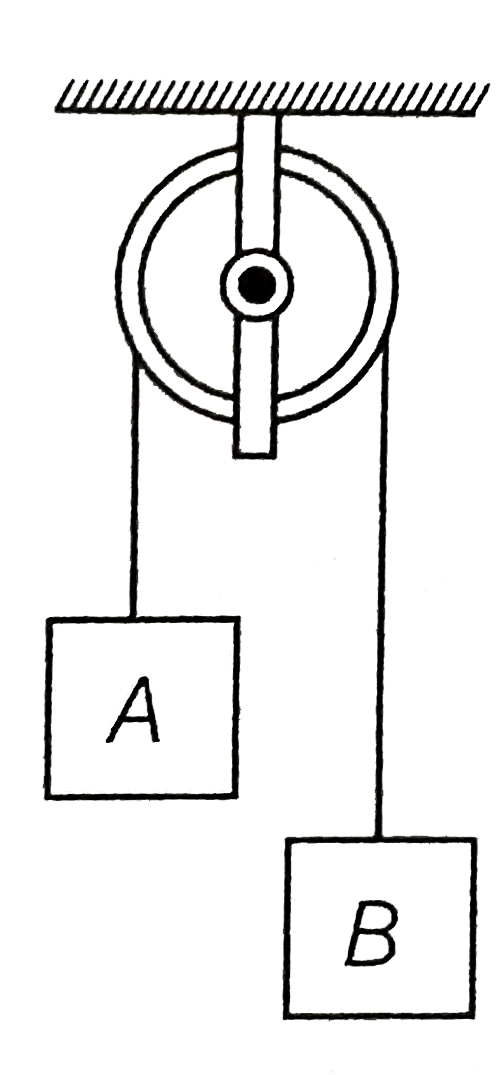
In the arrangement shown in figure, `m_(A) = 2kg` and `m_(B) = 1kg`. String is ligith and inextensible. Find the acceleration of center of mass of both the blocks. Neglect friction everywhere.

Text Solution

Verified by Experts
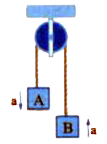
Net pulling force on the system is `(m_(A) - m_(B))g` or `(2-1)g=g`
Total mass being pulled is `m_(A) + m_(B)` or 3 kg

`therefore a = ("Net pulling force")/("Total mass") =g/3`= acceleration of each block.
Now, `veca_(CM) =(m_(A)veca_(A) + m_(B)veca_(B))/(m_(A) + m_(B)) =((2)(a) -(1)(a))/(1+2) =a/3 = g/9` downwards.
Promotional Banner

Similar Questions

Explore conceptually related problems

In the arrangement shown in Figure, m_A=2kg and m_B=1kg . String is light and inextensible. Find the acceleration of centre of mass of both the blocks. Neglect friction everywhere.

In the arrangement shown in Figure, m_A=2kg and m_B=1kg . String is light and inextensible. Find the acceleration of centre of mass of both the blocks. Neglect friction everywhere.

In the arrangment shown in figure, m_(A) =1 kg, m_(B) =4 kg. String is light and inextensible while pulley is smooth. Coefficient of friction between block A and the table is mu =0.2. Find the speed of both the blocks when block B has descended a height h=1 m. (Take ,g=10 ms^(-2) )

In the arrangement shown in fig. pulleys are smooth and massless. Threads are massless and inextensible. Find acceleration of mass m_(1) .

Two block A and B are arrenged as shown in figure (m_(A) = 5 kg and m_(B) = 10 kg) Find the acceleration of blocks if F = 40 N

In the arrangement shown in figure, string is light and inextensible and friction is absent every where. The speed of both blocks after the block 'A' has ascend a height of 1m will be (g=10 m//s^(2))

In the adjacent figure, masses of A,B and C are 1kg ,3kg and 2kg respectively. Find (a) the acceleration of the system and (b) tension in the strings. Neglect friction. (g=10m//s^(2))

In the adjacent figure, mass of A, B and C are 1 kg , 3 kg and 2 kg, respectively. Find (a) the acceleration of the system, and (b) tensions in the string . Neglect friction. (g =10ms^(-2) )

In the adjacent figure, mass of A, B and C are 1 kg , 3 kg and 2 kg, respectively. Find (a) the acceleration of the system, and (b) tensions in the string . Neglect friction. (g =10ms^(-2) )

In the adjacent figure, mass of A, B and C are 1 kg , 3 kg and 2 kg, respectively. Find (a) the acceleration of the system, and (b) tensions in the string . Neglect friction. (g =10ms^(-2) )

