Home
Class 11
PHYSICS
Assuming the earth to be a uniform spher...

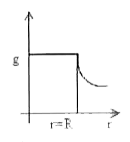
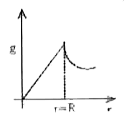
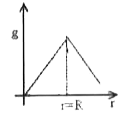
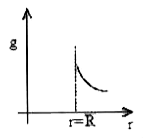
Assuming the earth to be a uniform sphere of mass M and radium R. which of the following graphs represents the variation of acceleration due to gravity with distance .r. from the centre of the earth.

A

B

C

D

Text Solution

AI Generated Solution

The correct Answer is:

To solve the problem of how the acceleration due to gravity (g) varies with distance (r) from the center of the Earth, we can break it down into two distinct regions: outside the Earth and inside the Earth. ### Step-by-Step Solution: 1. **Understanding the Problem**: - We need to analyze how the acceleration due to gravity changes as we move from the center of the Earth to a point outside its surface. 2. **Acceleration Outside the Earth** (r > R): - When we are outside the Earth (at a distance r from the center where r > R), we can treat the Earth as a point mass located at its center. - The formula for gravitational acceleration at a distance r from the center of a mass M is given by: \[ g = \frac{GM}{r^2} \] - Here, G is the gravitational constant, M is the mass of the Earth, and r is the distance from the center of the Earth. - As r increases, g decreases with the square of the distance (inversely proportional to \( r^2 \)). 3. **Acceleration At the Surface of the Earth** (r = R): - At the surface of the Earth (r = R), the acceleration due to gravity is: \[ g = \frac{GM}{R^2} \] 4. **Acceleration Inside the Earth** (r < R): - When we are inside the Earth (at a distance r from the center where r < R), we can use the concept of a uniform spherical shell. - According to the shell theorem, the gravitational force inside a uniform spherical shell is zero. Therefore, only the mass that is at a radius less than r contributes to the gravitational acceleration. - The effective mass \( m' \) that contributes to gravity at distance r is: \[ m' = \frac{4}{3} \pi r^3 \rho \] - Here, \( \rho \) is the density of the Earth. - The acceleration due to gravity inside the Earth is given by: \[ g' = \frac{G m'}{r^2} = \frac{G \left(\frac{4}{3} \pi r^3 \rho\right)}{r^2} = \frac{4}{3} \pi G \rho r \] - This shows that \( g' \) is directly proportional to r when r < R. 5. **Graphical Representation**: - From the analysis: - For r < R, g increases linearly with r. - For r = R, g reaches its maximum value. - For r > R, g decreases as \( \frac{1}{r^2} \). - Therefore, the graph of g vs. r will show a linear increase from the center to the surface, and then a decrease as we move away from the surface. 6. **Conclusion**: - The correct graph representing the variation of acceleration due to gravity with distance from the center of the Earth is option 2, which shows a linear increase up to R and then a decrease inversely proportional to \( r^2 \) beyond R.
Promotional Banner

Similar Questions

Explore conceptually related problems

Which graph correctley presents the variation of acceleration due to gravity with the distance form the centre of the earth?

Which of the following graphs shows the variation of acceleration due to gravity g with depth h from the surface of the earth ?

Which one of the following graphs represents the variation of electric field with distance r from the centre of a charged spherical conductor of radius R?

Which of the following graphs correctly represents the variation of g on the - Earth?

The acceleration due to gravity at a depth R//2 below the surface of the earth is

The diagram showing the variation of gravitational potential of earth with distance from the centre of earth is

Starting from the centre of the earth having radius R, the variation of g (acceleration due to gravity) is shown by

If earth is assumed to be a sphere of uniform density then plot a graph between acceleration due to gravity (g) and distance from the centre of earth.

Assuming the earth to be a homogeneous sphere of radius R , its density in terms of G (constant of gravitation) and g (acceleration due to gravity on the surface of the earth)

A satellite of mass m is moving in a circular or orbit of radius R around the earth. The radius of the earth is r and the acceleration due to gravity at the surface of the earth is g. Obtain expressions for the following : (a) The acceleration due to gravity at a distance R from the centre of the earth (b) The linear speed of the satellite (c ) The time period of the satellite
