Home
Class 11
PHYSICS
A force F is applied on the top of a cub...

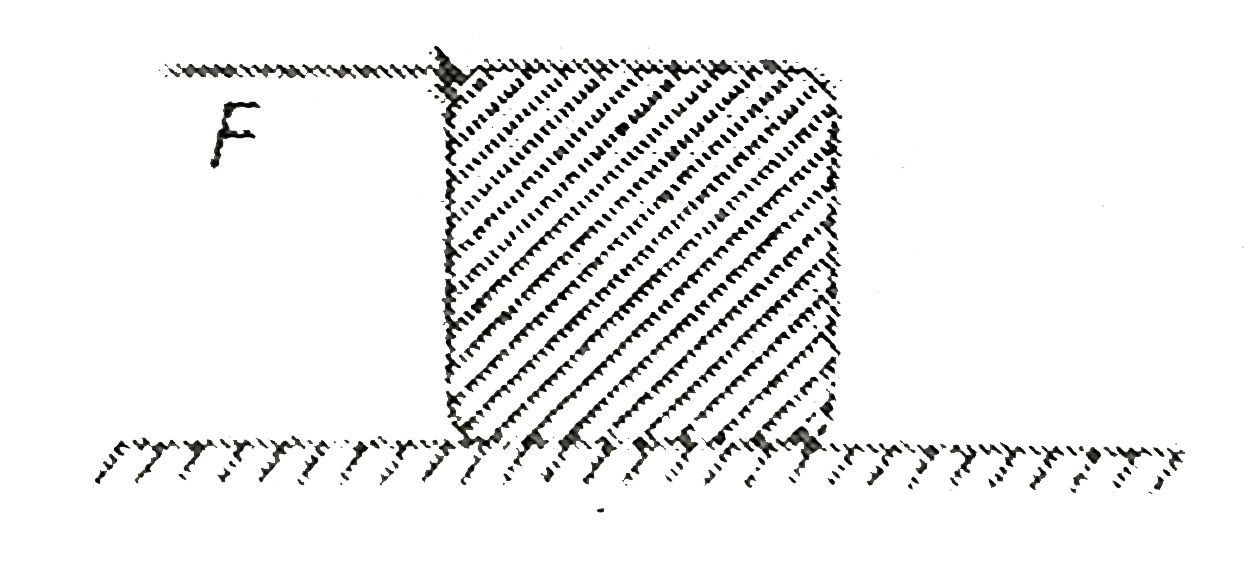
A force F is applied on the top of a cube as shown in figure. The cofficent of friction between the cube and the ground is `mu`. If F is gradually increased, the cube will topple before sliding if

Text Solution

Verified by Experts

Let m be the mass of cube and .a. the side of cube. The cube will slide if: `Fgtmumg" ".......(1)`
and it will topple if torque of F about P is greater than torque of mg about Pi.e.
`F.agt((a)/(2))mg, or Fgt(1)/(2)mg" "......(2)`
From equations (1) and (2) we see that cube will topple before sliding if `mugt(1)/(2)`
Promotional Banner

Similar Questions

Explore conceptually related problems

A force F is applied on the top of a cube as shown in the figure. The coefficient of friction between the cube and the ground is mu . If F is gradually increased, find the value of mu for which the cube will topple before sliding.

A cube is pplaced on an inclined plane of inclinbation theta as shown in figure. Cofficent of friction br=etween the cube and the plane is mu . As the angle theta is gradually increased, the cube slides before toppling if

Two blocks of masses m and 2 m are placed one over the other as shown in figure.The coefficient of friction between m and 2m is mu and between 2m and ground is (mu)/(3) . If a horizontal force F is applied on upper block and T is tension developed in string, then choose the incorrect alternative.

A ring of mass m and radius R is acted upon by a force F as shown in the figure. There os sufficient friction between the ring and the ground. The force of friciton force necessary for pure rolling is

An equilateral prism of mass m rests on a rough horizontal surface with cofficent of friction mu . A horizontal force F is applied on the prism as shown in the figure. If the cofficent of the friction is sufficently high so that the prism does not slide before toppling, then the minimum force required to topple the prism is

A cube of mass m is placed on top of a wedge of mass 2m, as shown in figure. There is no friction between the cube and the wedge. The minimum co - efficient of friction between the wedge and the horizontal surface, so that the wedge does not move is

A plank A of mass M rests on a smooth horizontal surface over which it can move without friction A cabe B of mass m lies on the plank at one edge .The coefficient of friction between the plank and the cube is mu The size of cube is very small in comparison to the plank. At what force F applied to the plank in the horizontal direction will be cube begin to slide towards the other end of the plank?

A cubical block of edge length 1 m and density 800 kg m^-3 rests on a rough horizontal surface with coefficient of friction mu . A horizontal force F is applied on the block as shown in figure. If the coefficient of friction is sufficiently large so that the block does not slide bofore toppling, then the minimum value of F to topple the block is [Take g = 10 ms^-2 ]

Suppose a block of mass 1kg is placed over a rought surface and a horizontal force F is applied on the block as shown in figure. Now let as see what are the values of force of friction f and acceleration of the block a if the force F is gradually increased. Given that mu_(s) =0.5,mu_(k) =0.4 and g=10m//s^(2)

Two bodies A and B of masses 10 kg and 5 kg placed very slightly seperated as shown in figure The coefficient of friction between the floor and the block are as mu_(s) = 0.4 block A is pushed by an external force F The value of F can be changed when the weight between block A and ground breaks block A will start pressing block B will start pressing the vertical wall The force of friction acting on B verius with the applied force F acceleration to curve
