Home
Class 11
PHYSICS
A disc rotating about its axis with angu...

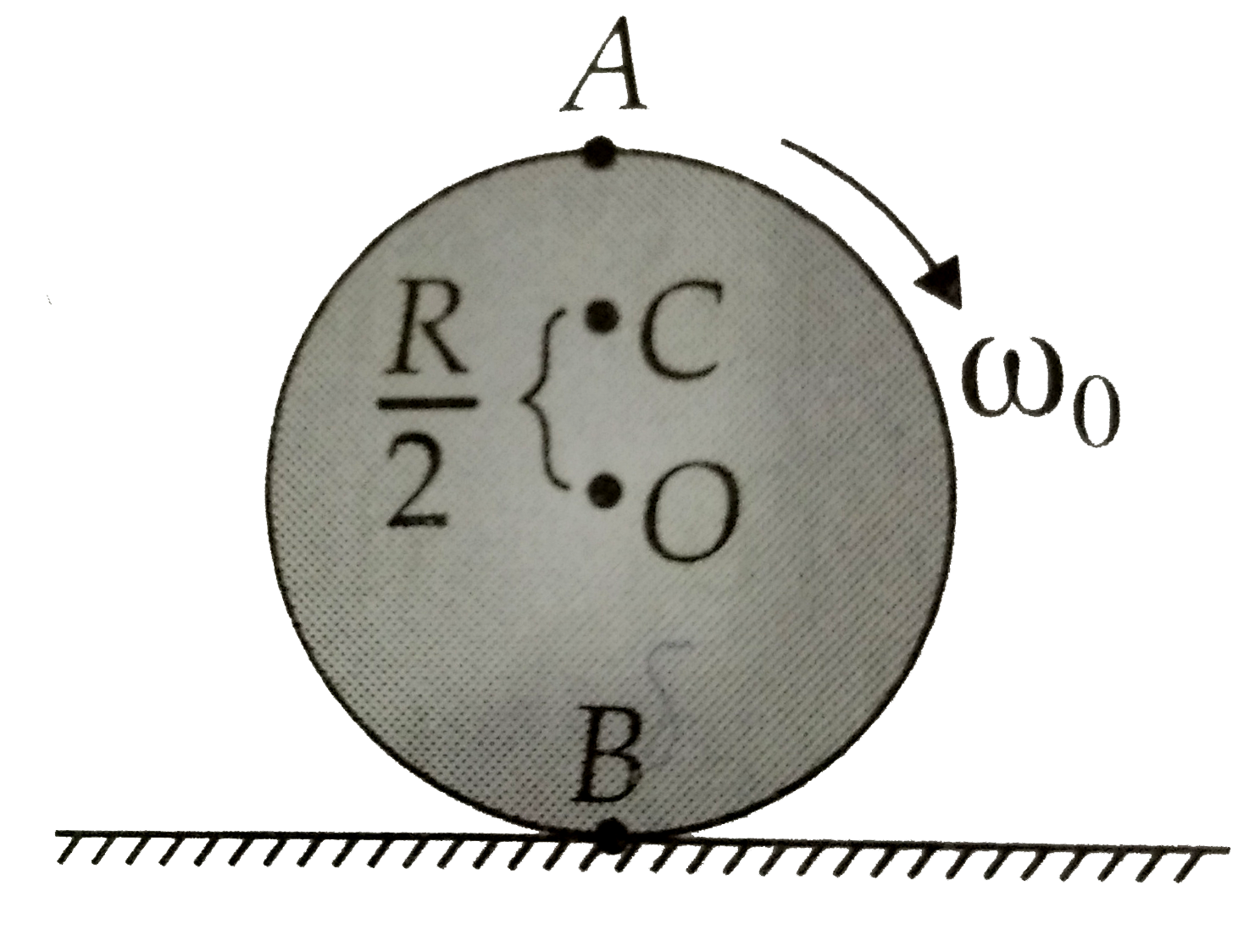
A disc rotating about its axis with angular speed `omega_o` is placed lightly (without any translational push) on a perfectly frictionless table. The radius of the disc is R.
Let `v_A, v_B and v_C` be the magnitudes of linear velocities of the points A, B and C on the disc as shown. Then

Text Solution

Verified by Experts

Velocity of `A=omega_(0)R`, which is in the same direction as the arrow.
b) Velocity of `B=omega_(0)R`, which is in a direction opposite to the arrow
c) Velocity of `C=omega_(0)R//2` which is the direction of the arrow.
d) The disc will not roll in the direction indicated as the table is perfectly frictionless and without friction a body cannot roll.
Promotional Banner

Similar Questions

Explore conceptually related problems

A disc rotating about its axis with angular speed omega_(0) is placed lightly (without any translational pull) on a perfectly frictionless table. The radius of the disc is R . What are the linear velocities of the points A, B and C on the disc shown in Fig. Will the disc roll in the direction indicated ?

A disc rotating about its axis with angular speed omega_(0) is placed lightly (without any translational pull) on a perfectly frictionless table. The radius of the disc is R . What are the linear velocities of the points A, B and C on the disc shown in Fig. Will the disc roll in the direction indicated ?

A disc rotating about its axis with angular speed is placed lightly {without any transnational push) on a perfectly friction-less table. The radius of the disc is R. What are the linear velocities of the point A, B and C on the disc shown in the Fig. B 7:2.60 ? Will the disc roll in the direction indicated ?

A disc is rolling without slipping on a horizontal surface with C, as its centre and Q and P the two points equidistant from C. Let v_(P),v_(Q) and v_(C) be the magnitudes of velocities of point P,Q and C respectively, then

A disc is rolling (without slipping) on a horizontal surface. C is its center and Q and P are two points equidistant from C . Let V_(P), V_(Q) and V_(C) be the magnitude of velocities of points P, Q and C respectively, then .

A disc of radius 10 cm is rotating about its axis at an angular speed of 20 rad/s. Find the linear speed of a. a point on the rim, b. the middle point of the radius.

A disc is rotated about its axis with a certain angular velocity and lowered gently on a rough inclined plane as shown in Fig., then

A disc is rotated about its axis with a certain angular velocity and lowered gently on a rough inclined plane as shown in Fig., then

A disc of radius R has linear velocity v and angular velocity omega as shown in the figure. Given upsilon=romega find velocity of point A, B, C and D on the disc.

the disc of the radius r is confined to roll without slipping at A and B if the plates have the velocities shown, determine the angular velocity of the disc.
