Home
Class 11
PHYSICS
The figure shows the variation of specif...

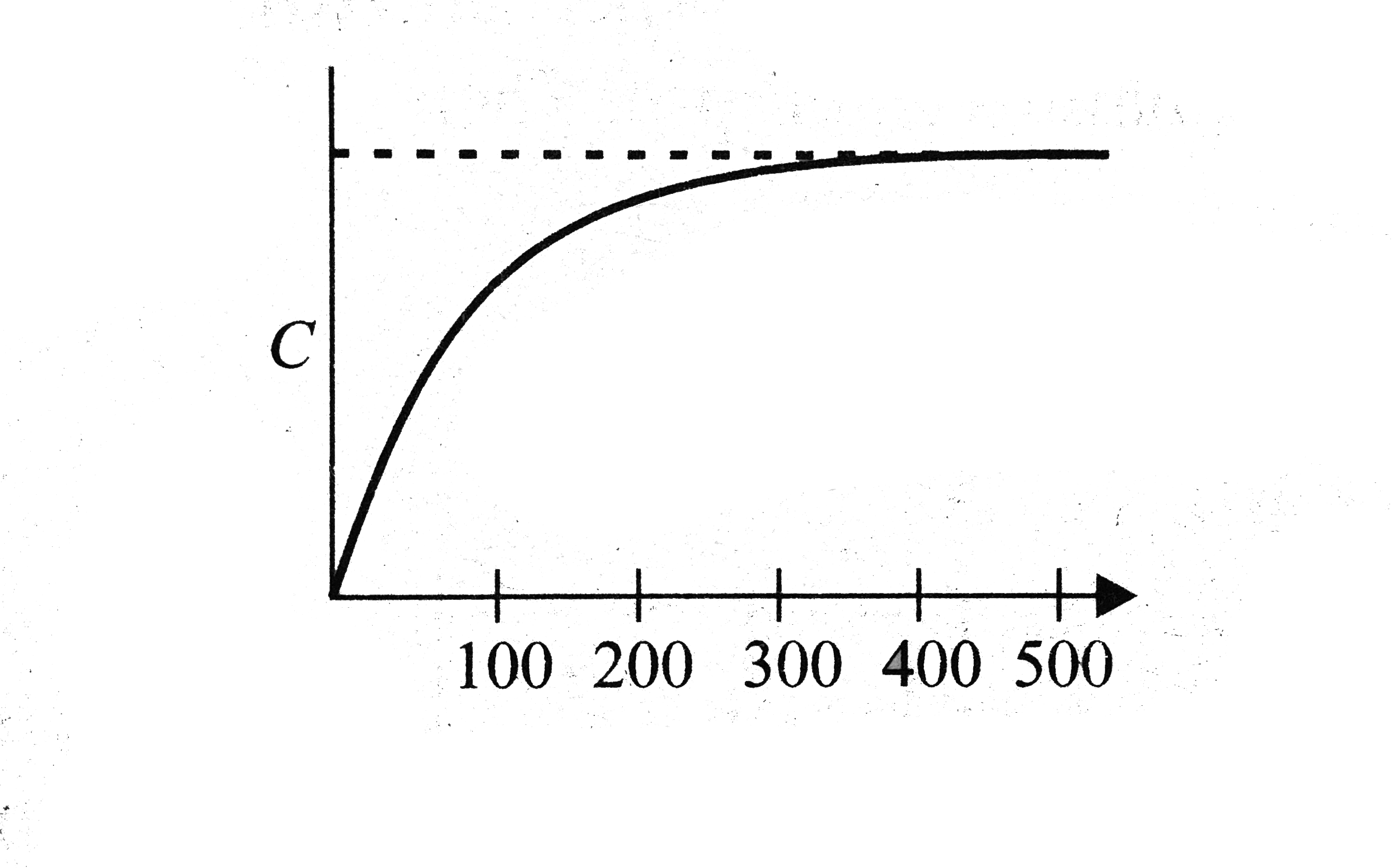
The figure shows the variation of specific heat capacity (C) of a solid as a function of temperature (T). The temperature is increased continuously from 0 to 500K at a constant rate. Ignoring any volume change, the following statement(s) is (are) correct to a reasonable approximation.

A

The rate at which heat is absorbed in the range 0 - 100K varies linearly with temperature T

B

Heat absorbed in increasing the temperature from 0-100K is less than the heat required for increasing the temperature from 400-500K

C

There is no change in the rate of heat absorption in the range 400-500K

D

The rate of heat absorption increase in the range 200-300K

Text Solution

Verified by Experts

The correct Answer is:

B, C, D
Promotional Banner

Similar Questions

Explore conceptually related problems

The figure below shows the variation of specific heat capacity (C) of a solid as a function of temperature (T). The temperature is increased continuously form 0 to 500K at a constant rate. Ignoring any volume change, the following statement (s) is (are) correct to a reasonable approximation.

The figure below shows the variation of specific heat capacity (C) of a solid as a function of temperature (T). The temperature is increased continuously form 0 to 500K at a constant rate. Ignoring any volume change, the following statement (s) is (are) correct to a reasonable approximation.

The figure below shows the variation of specific heat capacity (C) of a solid as a function of temperature (T). The temperature is increased continuously form 0 to 500K at a constant rate. Ignoring any volume change, the following statement (s) is (are) correct to a reasonable approximation.

Plots showing the variation of the rate constant (k) with temperature (T) are given below. The plot that follows the Arrhenius equation is

When 1 mole gas is heated at constant volume, temperature is raised from 298 to 308 K. Heat supplied to the gas in 500 J. Then, which statement is correct ?

The specific heat of many solids at low temperatures varies with absolute temperature T according to the relation S=AT^(3) , where A is a constant. The heat energy required to raise the temperature of a mass m of such a solid from T = 0 to T = 20 K is

Electrical resistance of certain materials, known as superconductors, changes abruptly from a nonzero value of zero as their temperature is lowered below a critical temperature T_(C) (0) . An interesting property of super conductors is that their critical temperature becomes smaller than T_(C) (0) if they are placed in a magnetic field, i.e., the critical temperature T_(C) (B) is a function of the magnetic field strength B. The dependence of T_(C) (B) on B is shown in the figure. . In the graphs below, the resistance R of a superconductor is shown as a function of its temperature T for two different magnetic fields B_1 (solid line) and B_2 (dashed line). If B_2 is larget than B_1 which of the following graphs shows the correct variation of R with T in these fields?

A metal rod lenth L_(0) whose coefficient of linear expansion alpha = 10^(-3) ^(0)C^(-1) is heated such that its temperature changes by 1000K assuming alpha is constant during the temperature change (e =2.7) . Which of the following statements are true

The variation of pressure with volume of the gas at different temperatures can be graphically represented as shown in figure. On the basis of this graph answer the following question. (i) How will the volume of a gas change if its pressure is increased at constant temperature ? (ii) At a constant pressure, how will the volume of a gas change if the temperature is increased from 200 K to 400 K ?

Let i_0 be the thermionic current from a metal surface when the absolute temperature of the surface is T_0 . The temperature is slowly increased and the thermionic current is measured as a function of temperature. Which of the following plots may represent the variation in (i/i_0) against (T/T_0) ?
