Home
Class 11
PHYSICS
Vector vec(A) is 2cm long and is 60^(@) ...

Vector `vec(A)` is 2`cm` long and is `60^(@)` above the x-axis in the first quadrant. Vector `vec(B)` is `2 cm` long and is `60^(@)` below the x-axis in the fourth quadrant. The sum `vec(A)+vec(B)` is a vector of magnitudes

Text Solution

Verified by Experts
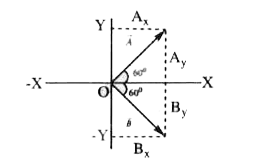

`vec(R) = vec(A) + vec(B)`
`vec(R) = 2 cos 60^(@) hat(i) + 2 sin 60hat(j) + 2 cos 60 hat(i) - 2 sin 60 hat(j)`
`vec(R) = 4 cos 60 hat(i) = 2hat(i)`
`therefore 2cm`, along x-axis
Promotional Banner

Similar Questions

Explore conceptually related problems

Vector vec(A) is 2 cm long and is 60^(@) above the x-axis in the first quadrant. Vactor vec(B) is 2 cm long and is 60^(@) below the x-axis in the fourth quadrant. The sum vec(A)+vec(B) is a vector of magnitudes

Vector vecA is 2 cm long and is 60° above the x - axis in the first quadrant, vector vecB is 2cm long and is 60° below the x - axis in the fourth quadrant. Find vecA + vecB

vec(A) and vec(B) are two vectors such that vec(A) is 2 m long and is 60^(@) above the x - axis in the first quadrant vec(B) is 2 m long and is 60^(@) below the x - axis in the fourth quadrant . Draw diagram to show vec(a) + vec(B) , vec(A) - vec(B) and vec(B) -vec(A) (b) What is the magnitude and direction of vec(A) + vec(B) , vec(A) - vec(B) and vec(B) - vec(A)

If vec(a) and vec(b) are the unit vectors and theta is the angle between them, then vec(a) + vec(b) is a unit vector if

If a vector vec(A) is parallel to another vector vec(B) then the resultant of the vector vec(A)xxvec(B) will be equal to

A vector vec(B) which has a magnitude 8.0 is added to a vector vec(A) which lies along the x-axis. The sum of these two vector is a third vector which lies along the y-axis and has a magnitude that is twice the magnitude of vec(A) . Find the magnitude of vec(A)

A vector vec(A) of length 10 units makes an angle of 60^(@) with a vector vec(B) of length 6 units. Find the magnitude of the vector difference vec(A)-vec(B) & the angles with vector vec(A) .

Let vec(AB) be a vector in two dimensional plane with magnitude 4 units. And making an anle of 60^0 with x-axis, and lying in first quadrant. Find the components of vec(AB) in terms of unit vectors hati and hatj . so verify that calculation of components is correct.

Keeping one vector constant, if direction of other to be added in the first vector is changed continuously, tip of the resultant vector describes a circles, In the following figure vector vec(a) is kept constant. When vector vec(b) addede to vec(a) changes its direction, the tip of the resultant vector vec(r)=vec(a)+vec(b) describes circles of radius b with its centre at the tip of vector vec(a) . Maximum angle between vector vec(a) and the resultant vec(r)=vec(a)+vec(b) is

If the vectors vec(a) + vec(b), vec(b) + vec(c) and vec(c) + vec(a) are coplanar, then prove that the vectors vec(a), vec(b) and vec(c) are also coplanar.

