Home
Class 11
PHYSICS
Two particles of equal mass go around a ...

Two particles of equal mass go around a circle of radius R under the action of their mutual gravitational attraction. Find the speed of each particle.

Text Solution

Verified by Experts
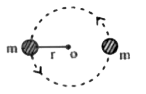

The particle will always remain diametrically opposite , so that the force on each particle will be directed along the radius.
When each particle is describing a circular orbit, the gravitational force on one of the particles must be equal to the necessary centripetal force ,
`(mV^2)/r =(Gmm)/((2r)^2)" " i.e V = sqrt((Gm)/r)`
Promotional Banner

Similar Questions

Explore conceptually related problems

Two particles of equal mass go round a circle of radius R under the action of their mutual gravitational attraction. Find the speed of each particle.

Two particles of equal mass go around a circle of radius R under the action of their mutual gravitational attraction. The speed v of each particle is

Two particles of equal masses m go round a circle of radius R under the action of their mutual gravitational attraction. The speed of each particle is v=sqrt((Gm)/(nR)) . Find the value of n.

Four particles of equal masses M move along a circle of radius R under the action of their mutual gravitational attraction. Find the speed of each particle.

Two particles of equal mass (m) each move in a circle of radius (r) under the action of their mutual gravitational attraction find the speed of each particle.

Four particles of equal mass are moving round a circle of radius r due to their mutual gravitational attraction . Find the angular velocity of each particle .

Four particles, each of mass M and equidistant from each other, move along a circle of radius R under the action of their mutual gravitational attraction. The speed of each particle is:

Four particles, each of mass M and equidistant from each other, move along a circle of radius R under the action of their mutual gravitational attraction. The speed of each particle is:

Four particles, each of mass M and equidistant from each other, move along a circle of radius R under the action of their mutual gravitational attraction. The speed of each particle is:

Two particles of equal mass m_(0) are moving round a circle of radius r due to their mutual gravitational interaction. Find the time period of each particle.

