Home
Class 11
PHYSICS
In a double star system one of mass m(1)...

In a double star system one of mass `m_(1)` and another of mass `m_(2)` with a separation d rotate about their common centre of mass. Then rate of sweeps of area of star of mass `m_(1)` to star of mass `m_(2)` about their common centre of mass is

Text Solution

Verified by Experts
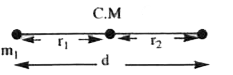

The gravitational force between the masses provides the necessary centripetal force
`(Gm_1m_2)/d^2 =m_(1)r_(1)omega^2rarr(1)`
The distance of centre of mass from `m_1` is
`r_(1)=(m_(2)d)/(m_1+m_2)rarr(2)`
From (1) and (2) `(Gm_1m_2)/d^2 =(m_1m_2d)/(m_1+m_2).omega^2`
(or) `omega^2=(G(m_1+m_2))/d^3 " (or) " omega=sqrt((G(m_1+m_2))/d^3)`
Promotional Banner

Similar Questions

Explore conceptually related problems

In a double star, two stars one of mass m_(1) and another of mass m_(2) , with a separation d, rotate about their common centre of mass. Find (a) an expression for their time period of revolution. (b) the ratio of their kinetic energies. (c) the ratio of their angular momenta about the centre of mass. (d) the total angular momentum of the system. (e) the kinetic energy of the system.

In a binary star system one star has thrice the mass of other. The stars rotate about their common centre of mass then :

Two stars of masses m_(1) and m_(2) distance r apart, revolve about their centre of mass. The period of revolution is :

Two stars of masses m_(1) and m_(2) distance r apart, revolve about their centre of mass. The period of revolution is :

A pair of stars rotates about a common centre of mass. One of the stars has a mass M and the other has mass m such that =2m. The distance between the centres of the stars is d ( d being large compare to the size of eithe star). The period of rotation of the stars about their common centre of mass ( in terms of d,m,G) is

Two stars of mass M_(1) & M_(2) are in circular orbits around their centre of mass The star of mass M_(1) has an orbit of radius R_(1) the star of mass M_(2) has an orbit of radius R_(2) (assume that their centre of mass is not acceleration and distance between starts is fixed) (a) Show that the ratio of orbital radii of the two stars equals the reciprocal of the ratio of their masses, that is R_(1)//R_(2) = M_(2)//M_(1) (b) Explain why the two stars have the same orbital period and show that the period T=2pi((R_(1)+R_(2))^(3//2))/(sqrt(G(M_(1)+M_(2)))) .

A pair of stars rotates about their centre of mass One of the stars has a mass M and the other has mass m such that M =2m The distance between the centres of the stars is d (d being large compared to the size of either star) . The ratio of the angular momentum of the two stars about their common centre of mass (L_(m)//L_(m)) is .

A binary star consists of two stars A(mass 2.2 M_s) and B (mass 11 M_s) where M_s is the mass of the sun, they are separted by distane d and are rotating about their center of mass, which is stationary. The ratio of the total angular momentum of the binary to the angular momentum of star B about the centre of mass is

Two particles of masses m_(1) and m_(2) (m_(1) gt m_(2)) are separated by a distance d. The shift in the centre of mass when the two particles are interchanged.

The rate of change of angular momentum of a system of particles about the centre of mass is equal to the sum of external torque about the centre of mass when the centre of mass is :

