Home
Class 11
PHYSICS
In a double star system two stars of mas...

In a double star system two stars of masses `m_(1)` and `m_(2)` separated by a distance 'd' rotates about their centre of mass. Then the common angular velocity and time period is

Text Solution

Verified by Experts
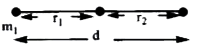

The gravitational force between the masses provides the necessary centripetal force
`(Gm_(1)m_(2))/(d) = m_(1)r_(1) omega^(2) rarr (1)`
The distance of centre of mass from `m_(1)` is
`r_(1) = (m_(2)d)/(m_(1)+m_(2))rarr (2)`,
From (1) and (2)
`(Gm_(1)m_(2))/(d^(2)) = (m_(1)m_(2)d)/(m_(1)+m_(2)).omega^(2)`
(or) `omega^(2) = (G(m_(1)+m_(2)))/(d^(3))` (or)
`omega = sqrt((G(m_(1) + m_(2)))/(d^(3)))`
Promotional Banner

Similar Questions

Explore conceptually related problems

Two stars of masses m_(1) and m_(2) distance r apart, revolve about their centre of mass. The period of revolution is :

Two stars of masses m_(1) and m_(2) distance r apart, revolve about their centre of mass. The period of revolution is :

For the double star system, the two stars having masses m_(1) and m_(2) are separated b a distance r . They are revolving about their common centre of mass in radii r_(1) and r_(2) respectively. Which of the following is/are incorrect.?

In a double star system one of mass m_(1) and another of mass m_(2) with a separation d rotate about their common centre of mass. Then rate of sweeps of area of star of mass m_(1) to star of mass m_(2) about their common centre of mass is

In a double star, two stars one of mass m_(1) and another of mass m_(2) , with a separation d, rotate about their common centre of mass. Find (a) an expression for their time period of revolution. (b) the ratio of their kinetic energies. (c) the ratio of their angular momenta about the centre of mass. (d) the total angular momentum of the system. (e) the kinetic energy of the system.

Two particles of masses m_(1) and m_(2) (m_(1) gt m_(2)) are separated by a distance d. The shift in the centre of mass when the two particles are interchanged.

A double star is a system of two stars of masses m and 2m , rotating about their centre of mass only under their mutual gravitational attraction. If r is the separation between these two stars then their time period of rotation about their centre of mass will be proportional to

In a binary star system one star has thrice the mass of other. The stars rotate about their common centre of mass then :

In a particular double star system two stars of mass 3.22xx10^(30) kg each revolve about their common centre of mass 1.12xx10^(11) on away. (i). Calculate their common period of revolution, in years (ii). Suppose that a meteoroid (small solid particle in space) passes through this centre of mass moving at right angles to the orbital plane of the stars. What must its speed be if it is to escape from the gravitational field of the double star?

Two masses m_(1) and m_(2) are placed at a distance r from each other. Find out the moment of inertia of system about an axis passing through their centre of mass.

