Home
Class 11
PHYSICS
P is a point at a distance r from the ce...

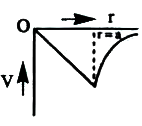
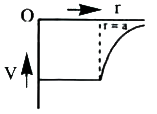
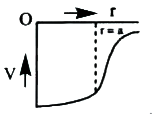
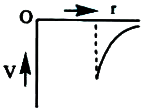
P is a point at a distance r from the centre of solid sphere of radius a. The gravitational potential at P is V. IF V is plotted as a function of r, which is the correct curve ?

A

B

C

D

Text Solution

AI Generated Solution

The correct Answer is:

To determine the correct curve for the gravitational potential \( V \) as a function of the distance \( r \) from the center of a solid sphere of radius \( a \), we will analyze the gravitational potential both inside and outside the sphere. ### Step 1: Understanding Gravitational Potential Inside the Sphere For a point \( P \) located at a distance \( r \) (where \( r < a \)) from the center of a solid sphere, the gravitational potential \( V \) is given by the formula: \[ V = -\frac{G M}{R} + \text{constant} \] Where \( M \) is the mass of the sphere and \( R \) is the distance from the center of the sphere to point \( P \). ### Step 2: Mass Inside Radius \( r \) The mass \( m_1 \) of the sphere of radius \( r \) can be expressed in terms of the density \( \rho \): \[ m_1 = \rho \cdot \frac{4}{3} \pi r^3 \] The remaining mass of the sphere outside this radius is: \[ M - m_1 = M - \rho \cdot \frac{4}{3} \pi r^3 \] ### Step 3: Gravitational Potential Inside the Sphere The gravitational potential inside the sphere can be derived as follows: \[ V(r) = -G \left( \frac{M - m_1}{a} \right) - \frac{G m_1}{r} \] Substituting \( m_1 \): \[ V(r) = -G \left( \frac{M - \rho \cdot \frac{4}{3} \pi r^3}{a} \right) - \frac{G \cdot \rho \cdot \frac{4}{3} \pi r^3}{r} \] This simplifies to: \[ V(r) = -\frac{G \rho \cdot 4 \pi}{3} \left( a^3 - r^2 \cdot r \right) \] ### Step 4: Gravitational Potential Outside the Sphere For points outside the sphere (where \( r > a \)), the gravitational potential is given by: \[ V(r) = -\frac{G M}{r} \] ### Step 5: Analyzing the Graph 1. **For \( r < a \)**: The potential \( V \) varies with \( r^2 \) and has a parabolic nature. 2. **For \( r > a \)**: The potential \( V \) varies inversely with \( r \), which is a hyperbolic nature. ### Conclusion The graph of gravitational potential \( V \) as a function of distance \( r \) will show a parabolic curve for \( r < a \) and will approach a hyperbolic decay for \( r > a \). Thus, the correct curve to represent \( V \) as a function of \( r \) is a combination of these two behaviors, typically represented as a continuous curve that transitions from parabolic to hyperbolic.
Promotional Banner

Similar Questions

Explore conceptually related problems

Potential at a point x-distance from the centre inside the conducting sphere of radius R and charged with charge Q is

A particle of mass M is placed at the centre of a uniform spherical shell of equal mass and radius a. Find the gravitational potential at a point P at a distance a/2 from the centre.

A particle of mass M is placed at the centre of a uniform spherical shell of equal mass and radius a. Find the gravitational potential at a point P at a distance a/2 from the centre.

A cavity of radius R//2 is made inside a solid sphere of radius R . The centre of the cavity is located at a distance R//2 from the centre of the sphere. The gravitational force on a particle of a mass 'm' at a distance R//2 from the centre of the sphere on the line joining both the centres of sphere and cavity is (opposite to the centre of cavity). [Here g=GM//R^(2) , where M is the mass of the solide sphere]

A cavity of radius R//2 is made inside a solid sphere of radius R . The centre of the cavity is located at a distance R//2 from the centre of the sphere. The gravitational force on a particle of a mass 'm' at a distance R//2 from the centre of the sphere on the line joining both the centres of sphere and cavity is (opposite to the centre of cavity). [Here g=GM//R^(2) , where M is the mass of the solide sphere]

Two spheres one of mass M has radius R . Another sphere has mass 4M and radius 2R . The centre to centre distance between them is 12 R . Find the distance from the centre of smaller sphere where (a) net gravitational field is zero, (b) net gravitational potential is half the potential on the surface of larger sphere.

A particle of mass M is placed at the centre of a uniform spherical shell of equal mass and radius a. Find the gravitational potential at a point P at a distance a/2 from the center.

Assertion : In moving from centre of a solid sphere to its surface, gravitational potential increases. Reason : Gravitational field strength increase.

A point charge Q is situated (outside) at a distance r from the centre of an uncharged conducting solid sphere of radius R. The potential due to induced charges (on the conductor) at a point B inside the conductor whose distance form the point charge is d is ______

A uniform solid of valume mass density rho and radius R is shown in figure. (a) Find the gravitational field at a point P inside the sphere at a distance r from the centre of the sphere. Represent the gravitational field vector vec(l) in terms of radius vector vec(r ) of point P. (b) Now a spherical cavity is made inside the solid sphere in such a way that the point P comes inside the cavity. The centre is at a distance a from the centre of solid sphere and point P is a distance of b from the centre of the cavity. Find the gravitational field vec(E ) at point P in vector formulationand interpret the result.
