Home
Class 11
PHYSICS
Two particles A and B move with constant...

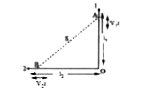
Two particles A and B move with constant velocity `vec(v_1)` and `vec(v_2)` along two mutually perpendicular straight lines towards intersection point O as shown in figure, At moment t = 0 particles were located at distance `l_1` and `l_2` respectively from O. Then minimu distance between the particles and time taken are respectively

A

`(|l_1v_2 - l_2v_1|)/(sqrt(v_1^2 +v_2^2)) , (l_1v_1 + l_2v_2)/(v_1^2 +v_2^2)`

B

`(|l_1v_1 - l_2v_2|)/(sqrt(v_1^2 +v_2^2)) , (l_1v_2 +l_2v_1)/(v_1^2 + v_2^2)`

C

`(|l_1v_2 - l_2v_1|)/(sqrt(v_1^2 + v_2^2)) sqrt(l_1/l_2) , ((l_1v_1 + l_2v_2)l_1)/((v_1^2 + v_2^2)l_2)`

D

`(|l_1v_2 - l_2v_1|)/(sqrt(v_1^2 + v_2^2)) sqrt(l_1/l_2) , ((l_1V_1 +l_2v_2)l_2)/((v_1^2 +v_2^2) l_1)`

Text Solution

Verified by Experts

The correct Answer is:

A
Promotional Banner

Similar Questions

Explore conceptually related problems

Two particles, 1 and 2, move with constant velocities v_1 and v_2 along two mutually perpendicular straight lines toward the intersection point O. At the moment t=0 the particles were located at the distances l_1 and l_2 from the point O. How soon will the distance between the particles become the smallest? What is it equal to?

Two ships, V and W, move with constant velocities 2 ms^(-1) and 4 ms^(-1) along two mutually perpendicular straight tracks toward the intersection point O. At the moment t=0 , the ships V & W were located at distances 100 m and 200 m respectively from the point O. The distance between them will be shortest at t= ........

Two ships, V and W, move with constant velocities 2 ms^(-1) and 4 ms^(-1) along two mutually perpendicular straight tracks toward the intersection point O. At the moment t=0 , the ships V & W were located at distances 100 m and 200 m respectively from the point O. The distance between them will be shortest at t= ........

Two particles 1 and 2 move with velocities vec v_1 and vec v_2 making the angles theta_1 and theta_2 with the line joining them, respectively. Find angular velocity of relative to 1 . .

A particle move with velocity v_(1) for time t_(1) and v_(2) for time t_(2) along a straight line. The magntidue of its average acceleration is

Two particles, 1 and 2, move with constant velocities v_1 and v_2 . At the initial moment their radius vectors are equal to r_1 and r_2 . How must these four vectors be interrelated for the particles to collide?

Two particles move with constant velocities towards point O along straight lines in a plane as shown. The shortest distance A and B is

A particle of mass m moves in the XY plane with constant velocity v along the straight line PQ as shown in the figure. Its angular momentum with respect to origin O is( theta is angle between vec v and x-axis)

Two particles are moving along two long straight lines, in the same plane with same speed equal to 20 cm//s. The angle between the two linse is 60^@ and their intersection point isO. At a certain moment, the two particles are located at distances 3m and 4m from O and are moving twowards O. Subsequently, the shortest distance between them will be

Two particles A and B are moving as shown in figure. At this moment of time, the angular speed of A with respect to B is?
