Home
Class 11
PHYSICS
A scooter can produce a maximum accelera...

A scooter can produce a maximum acceleration of `5ms^(-2)`. It brakes can produce a maximum retardation of `10ms^(-2)`. The minimum time in which it can cover a distance of 1.5km is?

Text Solution

Verified by Experts
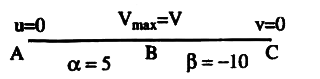

If v is the maximum velocity attained,
then during acceleration is between A, B
`v^(2)-o^(2)=2xx5xxS_(1)impliesS_(1)=(v^(2))/(10)`,
Also, during retardation
`o^(2)-v^(2)=2xx10xxS_(2)impliesS_(2)=(v^(2))/(20)`
`S=S_(1)+S_(2)implies1500=(v^(2))/(10)+(v^(2))/(20)=(3v^(2))/(20)or`
`v^(2)=(1500xx20)/(3)=10000 or v=100ms^(-1)`
`v=alphat_(1)impliest_(1)=(100)/(5)=20sec`
`v=betat_(2)impliest_(2)=(100)/(10)=10sec`
Total time `=20+10=30sec`.
Promotional Banner

Similar Questions

Explore conceptually related problems

A scooter can produce a maximum acceleration of 5ms^(-2) .Its brakes can produce a maximum retardation of 10ms^(-2) .The minimum time in which it can cover a distance of 1.5 km is?

The maximum acceleration that can be produced by the engine of a vehicle is 5ms^(-2) and the maximum retardation is brake can produce is 10ms^(-2) . Then the minimum time during which it can cover a distance of 60 m is

The driver of a train moving at 72 km h^(-1) sights another train moving at 4 ms^(-1) on the same track and in the same direction. He instantly applies brakes to produces a retardation of 1 ms^(-2) . The minimum distance between the trains so that no collision occurs is

A person can throw a stone to a maximum height of h meter. The maximum distance to which he can throw the stone is:

A particle executing SHM has a maximum speed of 0.5ms^(-1) and maximum acceleration of 1.0ms^(-2) . The angular frequency of oscillation is

A scooter starts from rest have an acceleration of 1 ms^(-2) while a car 150 m behind it starts from rest with an acceleration of 2ms^(-2) . After how much time the car catches up with the scooter ?

A force produces an acceleration of 4ms^(-2) in a body of mass m_(1) and the same force produces an acceleration of 6ms^(-2) in another body oa mass m_(2) . If the same force is applied to (m_(1)+m_(2)) , then the acceleration will be

Which of the following can produce maximum induced emf?

A body starts from rest and moves with uniform acceleration of 5 ms^(-2) for 8 seconds. From that time the acceleration ceases. Find the distance covered in 12s starting from rest.

A train is moving at a velocity of 25 "ms"^(-1) . If it is brought to rest by applying the brakes which produces a uniform retardation of 0.5 "ms"^(-2) . Calculate velocity of the train after 10s.

