Home
Class 11
PHYSICS
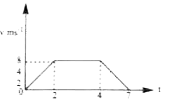
Figure given here shows the variation of...

Figure given here shows the variation of velocity of a particle with time.

Find the following:
(i) Displacement during the time intervals.
(a) 0 to 2 sec., (b) 2 to 4 sec. and (c) 4 to 7 sec
(ii) Accelerations at
(a)t = 1 sec, (b) t = 3 sec. and (c)t = 6 sec.
(iii) Average acceleration
(a) between t = 0 to t = 4 sec.
(b) between t = 0 to t = 7 sec.
(iv) Average velocity during the motion.

Text Solution

Verified by Experts

The correct Answer is:

i) a) 8m b) 16m c) 12m
ii) a) `4ma^(-2)` b) 0 c) `-8//3ms^(-2)`
iii) a) `2m//s^(2)` b) 0 iv) `(36)/(7)ms^(-1)`

i) displacement = Area enclosed between `v-t` graph and time axis.
ii) Acceleration = slope of `v-t` curve
iii) Average acceleration = `("Total change in velocity")/("Total time")`
(iv) Average velocity = `("Total displacement")/("Total time")`
Promotional Banner

Similar Questions

Explore conceptually related problems

Velocity of a particle varies with time as v=4t. Calculate the displacement of particle between t=2 to t=4 sec.

The position vector of a moving particle at't' sec is given by vecr = 3hati + 4t^(2)hatj - t^(3)hatk . Its displacement during an interval of t = Is to 3 sec is

The current through a 4.6 H inductor is shown in the following graph. The induced emf during the time interval t = 5 milli - sec to 6 milli - sec will be

The position of a particle varies with time according to the relation x=3t^(2)+5t^(3)+7t , where x is in m and t is in s. Find (i) Displacement during time interval t = 1 s to t = 3 s. (ii) Average velocity during time interval 0 - 5 s. (iii) Instantaneous velocity at t = 0 and t = 5 s. (iv) Average acceleration during time interval 0 - 5 s. (v) Acceleration at t = 0 and t = 5 s.

The acceleration of particle varies with time as shown. (a) Find an expression for velocity in terms of t. (b) Calculate the displacement of the particle in the interval from t = 2 s to t = 4 s. Assume that v = 0 at t = 0.

Position of a particle at any instant is given by x = 3t^(2)+1 , where x is in m and t in sec. Its average velocity in the time interval t = 2 sec to t = 3 sec will be :

A particle moves on a line according to the law s=at^(2)+bt+c . If the displacement after 1 sec is 16 cm, the velocity after 2 sec is 24 cm/sec and acceleration is 8cm//sec^(2) , then

The velocity (V) of a particle (in cm/s) is given in terms of time (t) in sec by the equation V=at+(b)/(c+t) . The dimensions of a, b and c are

If v=(t+2)(t+3) then acceleration (i.e(dv)/(dt)) at t=1 sec.

If v=(t^(2)-4t+10^(5)) m/s where t is in second. Find acceleration at t=1 sec.
