Home
Class 11
PHYSICS
On a smooth inclined plane a body of mas...

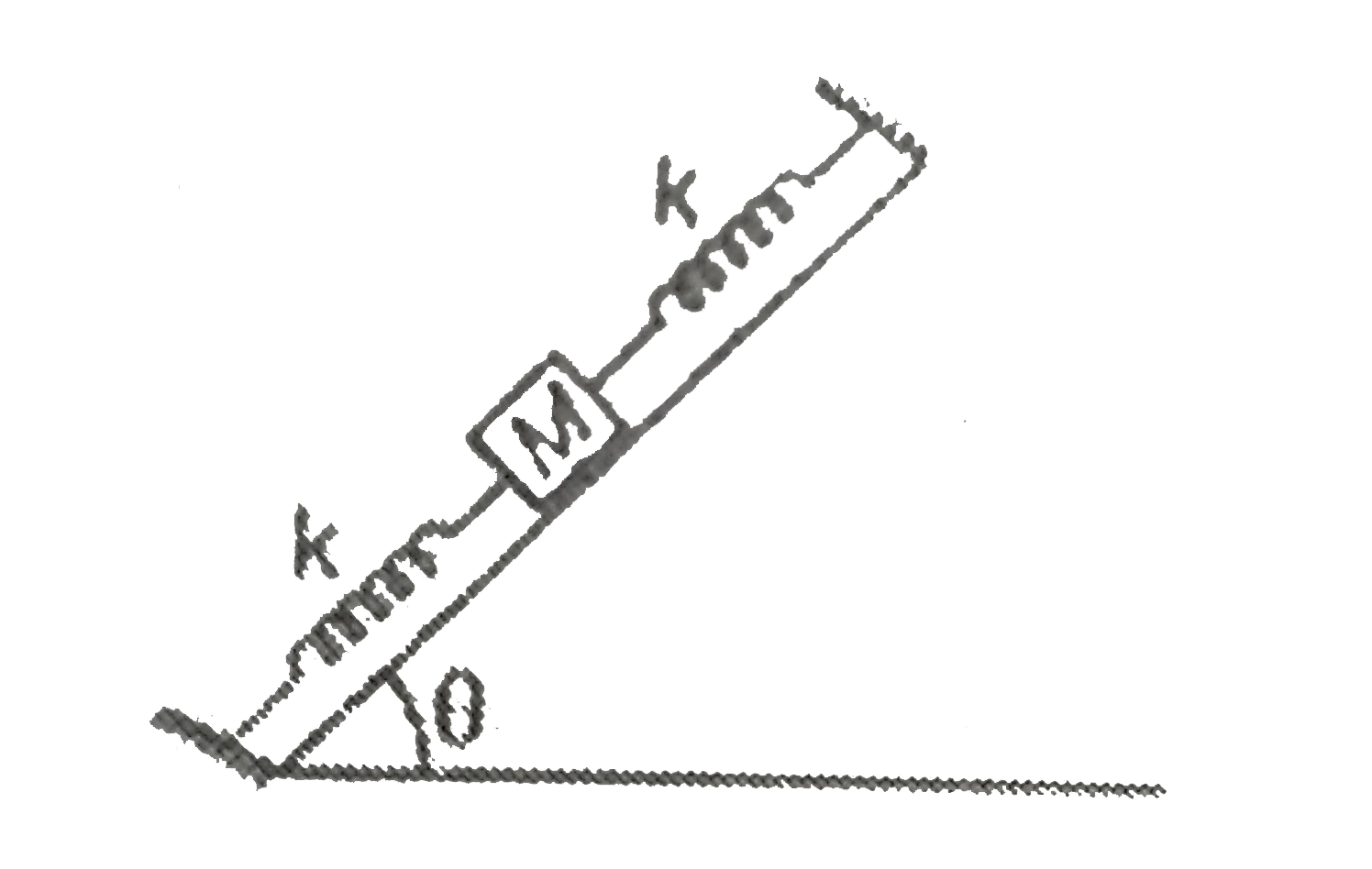
On a smooth inclined plane a body of mass M is attached between two springs. The other ends of the springs are fixed to firm supports. If each spring has a force constant k, the period of oscilation of the body is (assuming the spring as massless)

Text Solution

Verified by Experts
`k_(eff)=2K`
`:.T=2pisqrt(M/(2k))`
period (or `k_(eff)`) is independent of `theta`
Promotional Banner

Similar Questions

Explore conceptually related problems

On a smooth inclined plane, a body of mass M is attached between two springs. The other ends of the springs are fixed to firm supports. If each spring has force constant K , the period of oscillation of the body (assuming the springs as massless) is

In the adjacent figure, if the incline plane is smooth and the springs are identical then the period of oscillation of this body is

A block of mass m is placed on a smooth horizontal floor is attached to one end of spring. The other end of the spring is attached to fixed support. When spring is vertical it is relaxed. Now the block is pulled to wards right by a force F, which is being increased gradually. When the speing makes angle 53^(@) with the vertical, block leaves the floor. Force constant of the spring is :-

A block of mass m is tied to one end of a spring which passes over a smooth fixed pulley A and under a light smooth movable pulley B . The other end of the string is attached to the lower end of a spring of spring constant K_2 . Find the period of small oscillation of mass m about its equilibrium position (in second). (Take m=pi^2kg , K_2k=4K_1 , K_1=17(N)/(m). )

A light pulley is suspended at the lower end of a spring of constant k_(1) , as shown in figure. An inextensible string passes over the pulley. At one end of string a mass m is suspended, the other end of the string is attached to another spring of constant k_(2) . The other ends of both the springs are attached to rigid supports, as shown. Neglecting masses of springs and any friction, find the time period of small oscillations of mass m about equilibrium position.

A block of mass m is attached to a cart of mass 4m through spring of spring constant k as shown in the figure. Friction is absent everywhere. The time period of oscillations of the system, when spring is compressed and then released, is

A body of mass m attached to one end of an ideal spring of force constant k is executing simple harmonic motion. Establish that the time - period of oscillation is T=2pisqrt(m//k) .

A spring has natural length 40 cm and spring constant 500 N//m . A block of mass 1 kg is attached at one end of the spring and other end of the spring is attached to a ceiling. The block is relesed from the position, where the spring has length 45 cm .

Two spring are connected toa block of mass M placed a frictionless surface as shown if both the spring have a spring constant k the frequency of oscillation block is

Two identical springs of spring constant k are attached to a block of mass m and to fixed supports as shown in the figure. The time period of oscillation is

