Home
Class 11
PHYSICS
A block of mass 1 kg slides down a verti...

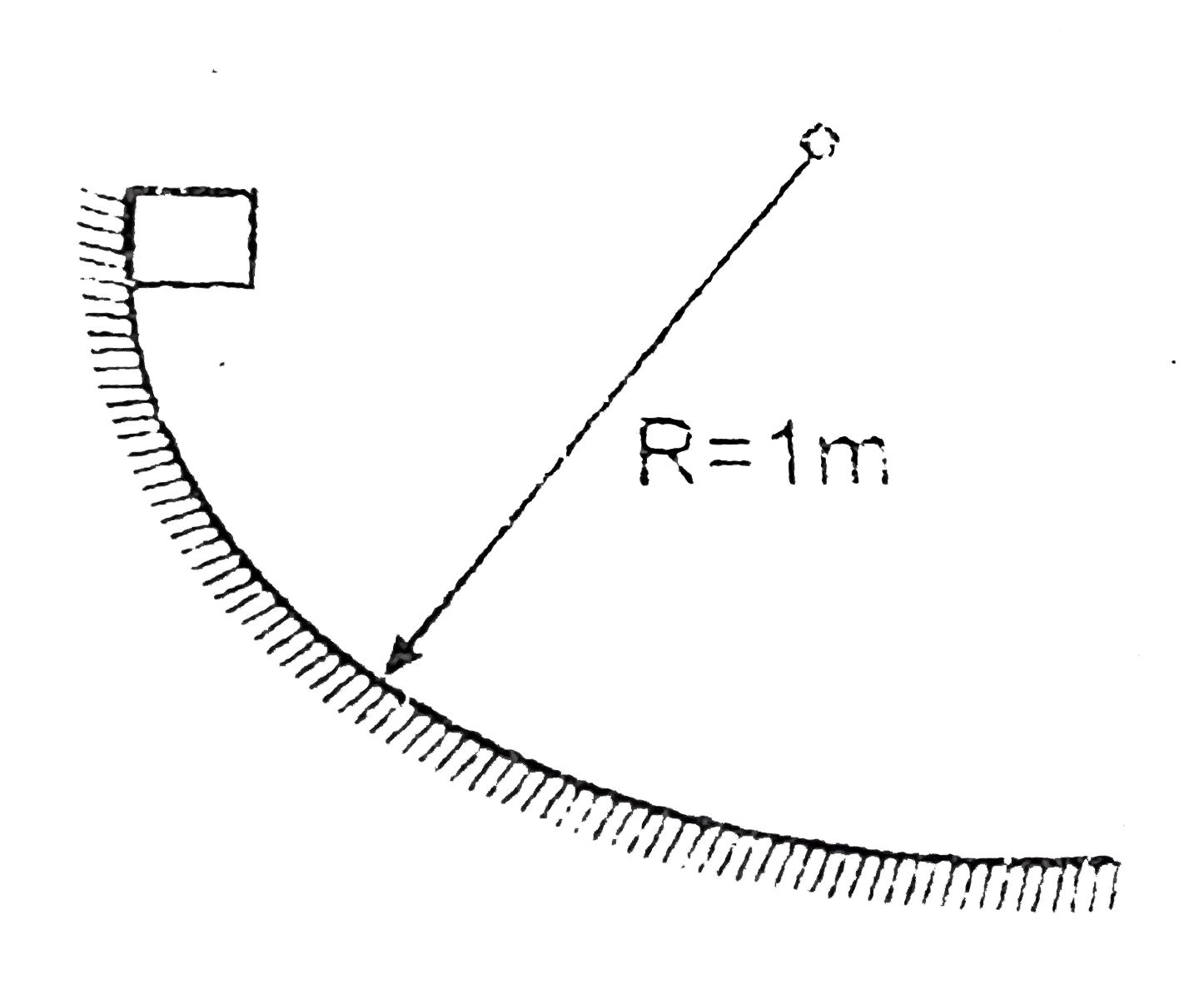
A block of mass 1 kg slides down a vertical curved track that is one quadrant of a circle of radius 1m. Its speed ast the the bottom si `2 m//s`. The work done by frictional force is :

A

`4m`

B

`3m`

C

`5 m`

D

`2m`

Text Solution

Verified by Experts

The correct Answer is:

A
Promotional Banner

Similar Questions

Explore conceptually related problems

A block of mass 1kg slides down a curved track which forms one quadrant of a circle of radius 1m as shown in figure. The speed of block at the bottom of track is v=2 ms^(-1) . The work done by the of friction is .

A block of mass m slides down a smooth vertical circular track. During the motion, the block is in

A body of mass 1 kg is rotated in a horizontal circle of radius 1 m and moves with velocity 2 ms^(-1) The work done in 10 revolutions is

A block of mass 5 kg slides down a rough inclined surface. The angle of inclination is 45^(@) . The coefficient of sliding friction is 0.20. When the block slides 10 cm, the work done on the block by force of friction is

A block of mass 4kg is released from the top of a rough inclines plane of height 10 m . If velocity of the block is 10 m//s at the bottom of the inclined then work done by the friction force on the block will be

A block of mass 1 kg is pulled slowly along the curve path ACB by a tangential force as shown in figure. The magnitude of work done by the frictional force when the block moves from A to B is

A block of mass 50 kg slides over a horizontal distance of 1m. If the coefficient of friction between their surface is 0.2, then work done against friction is (take g = 9.8 m//s^(2) ) :

A block of mass 1 kg slides down a rough inclined plane of inclination 60^(@) starting from its top. If coefficient of kinetic is 0.5 and length of the plane d=2 m, then work done against friction is

A block of mass 5.0 kg slides down an incline of inclination 30^0 and length 10 m. find the work done by the force of gravity.

A body is mass m is rotating in a vertical circle of radius 'r' with critical speed. The difference in its K.E at the top and at the bottom is
