Home
Class 11
PHYSICS
A cylindrical vessel contains a liquid o...

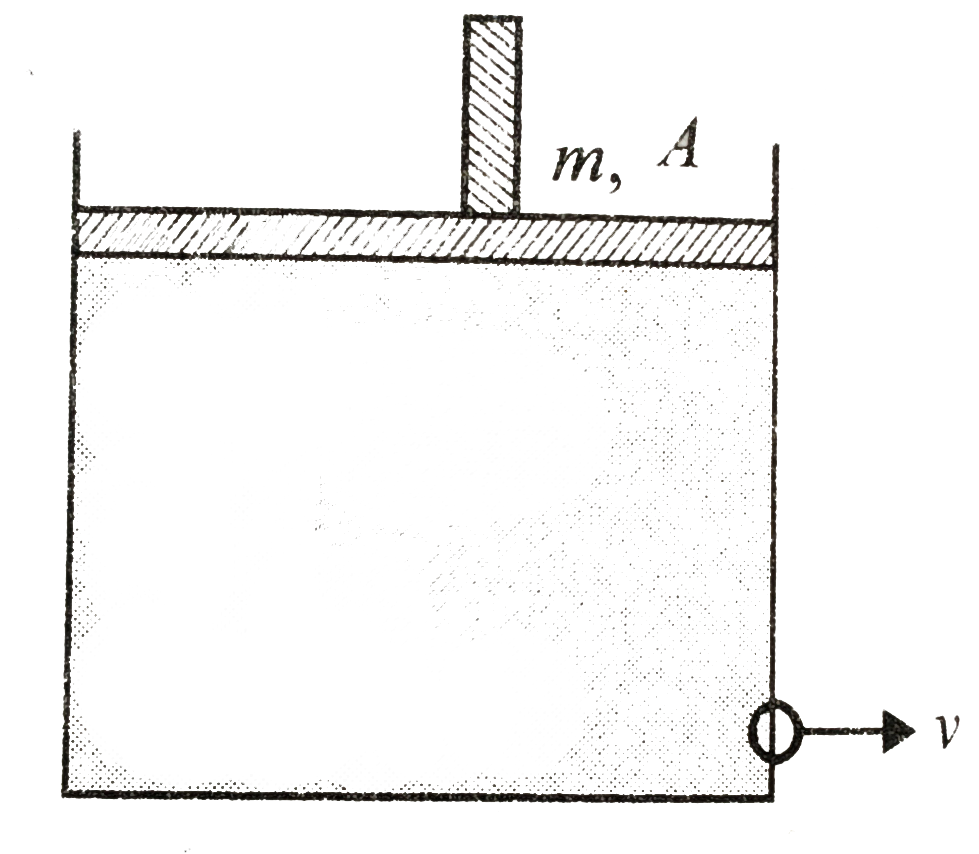
A cylindrical vessel contains a liquid of density `rho` up to height `h`. The liquid is closed by a piston of mass `m` and area of cross section `A`. There is a small hole at the bottom of the vessel. The speed `v` with which the liquid comes out of the hole is

Text Solution

Verified by Experts

Applying Bernoulli.s theorem at 1 and 2: difference in pressure
energy between 1 and 2=difference in kinetic energy between 1 and 2
or `rhogh+(mg)/(A)=(1)/(2)rhoV^(2)` or `v=sqrt(2gh+(2mg)/(rhoA))=sqrt(2(gh+(mg)/(rhoA)))`
Promotional Banner

Similar Questions

Explore conceptually related problems

In a cylindrical vessel containing liquid of density rho there are two holes in the side walls at heights of h_(1) and h_(2) respectively such that the range of efflux at the bottom of the vessel is same. The height of a hole for which the range of efflux would be maximum, will be

A cylindrical vessel containing a liquid is closed by a smooth piston of mass m as shown in the figure. The area of cross section of the piston is A. If the atmospheric pressure is P_0 , find the pressure of the liquid just below the piston. ,

A cylidrical vesel containing a liquid is closed by a smooth piston of mass m as shown in the figure. The area of cross section of the piston is A. If the atmospheric pressure is P_0 , find the pressure of the liquid just below the piston. ,

A liquid of density rho is filled in a vessel up to height H and a hole of cross section area A is made at a depth h below the free surface of liquid. The speed of liquid coming out of the hole is independent of

A cylindrical vessel of area of cross section A is filled with a liquid up to a height H . A very small hole of area of cross section a is made at the bottom of the vellel. Find the time taken by the vessel to become empty.

In the adjacent figure a cylindrical vessel of mass M and cross - sectional area A is placed inverted on a fixed smooth piston of same cross - sectional area fixed to the ground . The space between the cylinder and priston is completely filled with liquid of density rho . There is a small office of cross - sectional area a ( a lt lt A) at the top top portion of this vessel . ( intially length of the liquid column in the vessel is H ) Speed of the liquid with which it comes out of the vessel is

In the adjacent figure a cylindrical vessel of mass M and cross - sectional area A is placed inverted on a fixed smooth piston of same cross - sectional area fixed to the ground . The space between the cylinder and priston is completely filled with liquid of density rho . There is a small office of cross - sectional area a ( a lt lt A) at the top top portion of this vessel . ( intially length of the liquid column in the vessel is H ).Find the speed of the vessel with which it move

Two identical cylindrical vessel with their bases at the same level each contain a liquid of density rho . The height of the liquid in one vessel is h_(1) and in the other is h_(2) the area of either base is A. What is the work done by gravity is equalising the levels when the two vessels are connected?

A cylindrical vessel containing a liquid is rotated about its axis so that the liquid rises at its sides as shown in the figure . The radius of vessel is 5 cm and the angular speed of rotation is omega rad s^(-1) . The difference in the height , h ( in cm ) of liquid at the centre of vessel and at the side will be :

A cylinider is filled with non viscous liquid of density d to a height h_(0) and a hole is made at a height h_(1) from the bottom of the cylinder. The velocity issuing out of the hole is
