Home
Class 11
PHYSICS
Two particles of equal mass go around a ...

Two particles of equal mass go around a circle of radius R under the action of their mutual gravitational attraction. Find the speed of each particle.

Text Solution

Verified by Experts
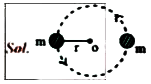

The particle will always remain diametrically opposite, so that the force on each particle will be directed along the radius.
When each particle is describing a circular orbit, the gravitational force on one of the particles must be equal to the necessary centripetal force.
`(mV^(2))/(r) = (Gm m)/((2r)^(2)) " "` i.e, `V = sqrt((Gm)/(4r))`
Promotional Banner

Similar Questions

Explore conceptually related problems

Two particles of equal mass go round a circle of radius R under the action of their mutual gravitational attraction. Find the speed of each particle.

Two particles of equal mass go around a circle of radius R under the action of their mutual gravitational attraction. The speed v of each particle is

Two particles of equal masses m go round a circle of radius R under the action of their mutual gravitational attraction. The speed of each particle is v=sqrt((Gm)/(nR)) . Find the value of n.

Four particles of equal masses M move along a circle of radius R under the action of their mutual gravitational attraction. Find the speed of each particle.

Two particles of equal mass (m) each move in a circle of radius (r) under the action of their mutual gravitational attraction find the speed of each particle.

Four particles of equal mass are moving round a circle of radius r due to their mutual gravitational attraction . Find the angular velocity of each particle .

Four particles, each of mass M and equidistant from each other, move along a circle of radius R under the action of their mutual gravitational attraction. The speed of each particle is:

Four particles, each of mass M and equidistant from each other, move along a circle of radius R under the action of their mutual gravitational attraction. The speed of each particle is:

Four particles, each of mass M and equidistant from each other, move along a circle of radius R under the action of their mutual gravitational attraction. The speed of each particle is:

Two particles of equal mass m_(0) are moving round a circle of radius r due to their mutual gravitational interaction. Find the time period of each particle.

