Home
Class 11
PHYSICS
A particle is moving along a circular pa...

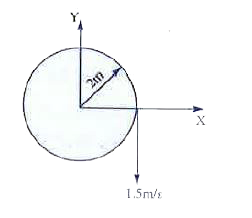
A particle is moving along a circular path in xy-plane. When it crosses x-axis, it has an acceleration along the path of `1.5m//s^(2)`, and is moving with a speed of 10m/s in -ve y - direction. The total acceleration is

A

`50 hati -1.5 hatj m //s^2`

B

`10 hati - 1.5 hatj m//s^2`

C

`-50 hati - 1.5 hatj m//s^2`

D

`1.5 hati - 50 hatj m//s^2`

Text Solution

Verified by Experts

The correct Answer is:

C
Promotional Banner

Similar Questions

Explore conceptually related problems

A particle is moving on a circular path with constant speed, then its acceleration will be constant in

A particle is moving on a circular path of radius 1 m with 2 m/s. If speed starts increasing at a rate of 2m//s^(2) , then acceleration of particle is

A particle is moving around a circular path with uniform angular speed (x) . The radius of the circular path is (r). The acceleration of the particle is:

A particle is moving along an elliptical path with constant speed. As it moves from A to B, magnitude of its acceleration :

A particle is revolving in a circular path of radius 2 m with constant angular speed 4 rad/s. The angular acceleration of particle is

A particle moves with constant speed v along a circular path of radius r and completes the circle in time T. The acceleration of the particle is

A particle is moving along a circular path with uniform speed. Through what angle does its angular velocity change when it completes half of the circular path ?

A particle is moving along a circular path of radius 5 m with a uniform speed 5ms^(-1) . What will be the average acceleration when the particle completes half revolution?

A particle is moving on a circular path of 10 m radius. At any instant of time, its speed is 5ms^(-1) and the speed is increasing at a rate of 2ms^(-2) . At this instant, the magnitude of the net acceleration will be

A particle starts moving in a circular path of radius R with an initial speed v_(0) clockwise. If the angular acceleration is alpha rad//s^(2) anticlockwise, the time when the acceleration and the velocity vectors of the particle become parallel, is
