Home
Class 11
PHYSICS
A string of neglisible mass going over a...

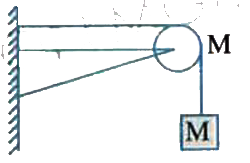
A string of neglisible mass going over a clamped pulley of mass m supports a block of mass M as shown in figure. Find the force on the pulley by the clamp.

A

`sqrt2 Mg `

B

`sqrt2 mg `

C

`g sqrt((M+m)^2 + m^2)`

D

`g sqrt((M+m)^2 +M^2)`

Text Solution

Verified by Experts

The correct Answer is:

D
Promotional Banner

Similar Questions

Explore conceptually related problems

A string of negligible mass going over a clamped pulley of mass m supports a block of mass M as shown in the figure. The force on the pulley by the clamp is given by

A string of negligible mass going over a clamped pulley of mass m supports a block of mass M as shown in the figure. The force on the pulley by the clamp is given by

A spring of negligible mass going over a clamped pulley of mass m supports a block of mass M as shown in the figure. The force on the pulley by the clamp at the time of equilibrium is given by

A string of negligible mass going over a clamped pulley of mass M as shown in Fig. 3.14. The force on pulley by the clamb is given by

A string of negligible mass passes over a pulley of mass m which is clamped. It supports a block of mass M at its lower free end. What is force exerted on pulley by the support ?

A string is wrapped on a wheel of moment of inertia 0.20 kg-m^2 and radius 10 cm and goes through a light pulley to support a block of mass 2.0 kg as shown in figure. Find the acceleration of the block.

A block of mass m hangs by means of a string which goes over a pulley of mass m and moment of inertia l, as shown in the diagram. The string does not realtive to the pulley. Find the frequency of small oscillations.

Figure shows a light platform on which a man of mass M is standing and holding a string passing over a system of ideal pulleys. Another mass m is hanging as shown in fig. Find the force the man has to exert to maintain the equlibrium of system, and find the force exerted by the platform on the man. Also find the ratio of M//m .

find the acceleration of the block of mass M in the situation shown in figure. All the surfaces are frictionless and the pulleys and the string are light.

Two blocks A and B of equal masses are attached to a string passing over a smooth pulley fixed to a wedge as shown in figure. Find the magnitude of acceleration of centre of mass of the two blocks when they are released from rest. Neglect friction.
