Home
Class 11
PHYSICS
The velocity of a particle moving in the...

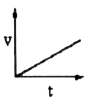
The velocity of a particle moving in the positive direction of the X-axis varies as `V = KsqrtS` where K is a positive constant. Draw V-t graph.

Text Solution

Verified by Experts
`V=Ksqrt(s)`
`(dS)/(dt)=Ksqrt(S) therefore underset(0)overset(S)int(dS)/(sqrt(S))=underset(0)overset(t)intKdt`
`therefore 2sqrt(S)=Kt and S=(1)/(4)K^(2)t^(2)`
`impliesV=(dS)/(dt)=(1)/(4)K^(2)2t=(1)/(2)K^(2)t`
`therefore Vpropt`
`therefore` The `V-t` graph is a straight line passing through the origin
Promotional Banner

Similar Questions

Explore conceptually related problems

The velocity of a particle moving in the positive direction of x -axis varies as v = alpha sqrt(x) where alpha is positive constant. Assuming that at the moment t = 0 , the particle was located at x = 0 , find (i) the time dependance of the velocity and the acceleration of the particle and (ii) the mean velocity of the particle averaged over the time that the particle takes to cover first s meters of the path.

The velocity of a particle moving in the positive direction of the x axis varies as v=alphasqrtx , where alpha is a positive constant. Assuming that at the moment t=0 the particle was located at the point x=0 , find: (a) the time dependence of the velocity and the acceleration of the particle, (b) the mean velocity of the particle averaged over the time that the particle takes to cover the first s metres of the path.

The velocity of a particle moving in the positive direction of x-axis veries as v=10sqrtx . Assuming that at t=0 , particle was at x=0

The velocity of a particle moving in the positive direction of X-axis varies as v=5sqrt(x) . Assuming that at t = 0, particle was at x = 0. What is the acceleration of the particle ?

A particle constrained to move along x-axis given a velocity u along the positive x-axis. The acceleration ' a ' of the particle varies as a = - bx, where b is a positive constant and x is the x co-ordinate of the position of the particle . Then select the correct alternative(s): .

The linear speed of a particle moving in a circle of radius R varies with time as v = v_0 - kt , where k is a positive constant. At what time the magnitudes of angular velocity and angular acceleration will be equal ?

The velocity v of a particle moving along x - axis varies with ist position (x) as v=alpha sqrtx , where alpha is a constant. Which of the following graph represents the variation of its acceleration (a) with time (t)?

A particle located at position x=0, at time t=0, starts moving along the positive x-direction with a velocity v^2=alpha x (where alpha is a positive constant). The displacement of particle is proportional to

The instantaneous velocity of a particle moving in a straight line is given as a function of time by: v=v_0 (1-((t)/(t_0))^(n)) where t_0 is a constant and n is a positive integer . The average velocity of the particle between t=0 and t=t_0 is (3v_0)/(4 ) .Then , the value of n is

A particle of unit mass is moving along x-axis. The velocity of particle varies with position x as v(x). =alphax^-beta (where alpha and beta are positive constants and x>0 ). The acceleration of the particle as a function of x is given as

