Home
Class 11
PHYSICS
A particle of mass m is moving along the...

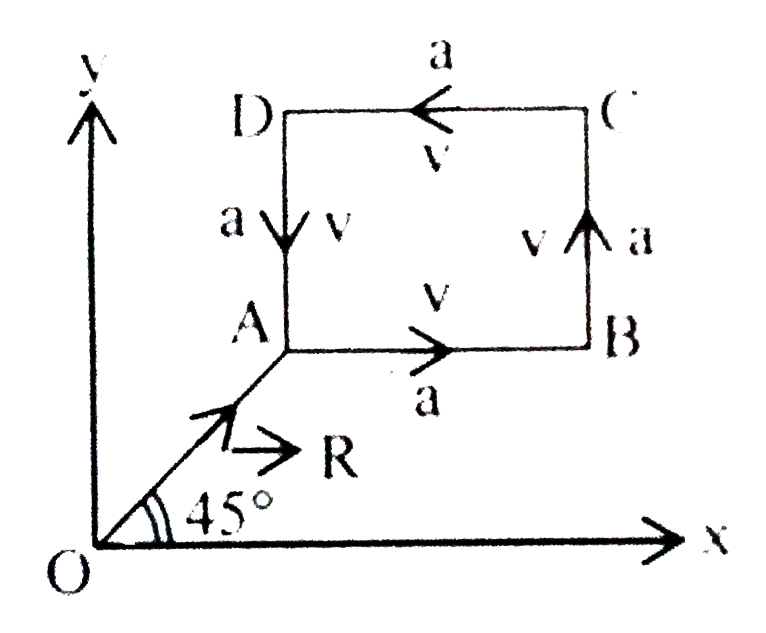
A particle of mass m is moving along the side of a square of side ‘a’, with a uniform speed v in the x-y plane as shown in the figure : Which of the following statements is false for the angular momentum `vec L` about the origin ?

A

`barL= (mv)/(sqrt(2))R hatk` when the particle is moving from D to A

B

`barL= -(mv)/(sqrt(2))R hatk` when the particle is moving from A

C

`barL= mv[(R )/(sqrt(2))-a] hatk` when the particle is moving from C to D

D

`barL= mv[(R )/(sqrt(2))+a] hatk` when the particle is moving from B to C.

Text Solution

Verified by Experts

Promotional Banner

Similar Questions

Explore conceptually related problems

A particle of mass m is moving along the side of a square of side a , with a uniform speed v in XY plane as shown in Fig. Which of the followig statements is false for the angular momentum overset rarr(L) about the origin?

A particle of mass m is moving on a circular path of radius r with uniform speed v , rate of change of linear momentum is

A particle with the position vector r has linear momentum p. Which of the following statements is true is respect of its angular momentum L about the origin ?

A particle of mass 'm' is moving on a circular path of radius 'r' with uniform speed 'v'. Rate of change of linear momentum is

A particle of mass 5g is moving with a uniform speed of 3sqrt2 cm//s in the x-y plane along the line y=x+4 . The magnitude of its angular momentum about the origin in g cm^(2)//s is

A disc of mass M and radius R moves in the x-y plane as shown in the figure. The angular momentum of the disc at tihe instant shows is

A mass m is moving with velocity (bar v) along a line y = x as shown in the figure. Which one is correct statement about angular momentum L_A , and L_B about the points A and B respectively?

A particle of mass m is moving with constant velocity v parallel to the x-axis as shown in the figure. Its angular momentum about origin O is

A particle is moving with constant speed v in xy plane as shown in figure. The magnitude of its angular velocity about point O is

A particle is moving in x-y plane as shown in the figure. Angular velocity of the particle with respect to the origin is

