Home
Class 11
PHYSICS
An insect crawls up a hemispherical surf...

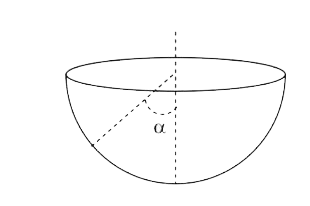
An insect crawls up a hemispherical surface very slowly. The coefficient of friction between the insect and the surface is 1/3. If the line joining the centre of the hemispherical surface to the insect makes an angle `alpha` with the vertical, the maximum possible value of is given by:

Text Solution

Verified by Experts

`cot^(-1)(3)`
Promotional Banner

Similar Questions

Explore conceptually related problems

An insect craws up a hemispherical surface very slowly (see fig.). The coefficient of friction between the insect and the surface is 1//3 . If the line joining the center of the hemispherical surface to the insect makes an angle alpha with the vertical, the maximum possible value of alpha is given by

An insect craws up a hemispherical surface very slowly (see fig.). The coefficient of friction between the insect and the surface is 1//3 . If the line joining the center of the hemispherical surface to the insect makes an angle alpha with the vertical, the maximum possible value of alpha is given by

An insect craws up a hemispherical surface very slowly (see fig.). The coefficient of friction between the insect and the surface is 1//3 . If the line joining the center of the hemispherical surface to the insect makes an angle alpha with the vertical, the maximum possible value of alpha is given by

An insect crawls up a hemispherical surface as shown (see the figure) the coefficient offriction between the insect and the surface is 1/3. If the line joining the centre of the hemisperical surface to the insect makes an angle theta with the vertical, the maximum possible value of theta is given by

The coefficient of friction between two surface is 0.2. The maximum angle of friction is

If the coefficient of friction between an insect and bowl is mu and the radius of the bowl is r, find the maximum height to which the insect can crawl in the bowl.

If the coefficient of friction between an insect and bowl is mu and the radius of the bowl is r, find the maximum height to which the insect can crawl in the bowl.

A particle is pulled along a curved surface very slowly. The coefficient of kinetic friction between the particle and surface is 0.4 . The heat generated during the pulling of the particle from the lowest point A to the topmost point B equals (The mass of the particle is 5 g )

If the coefficient of friction between M and the inclined surfaces is mu = 1//sqrt(3) find the minimum mass m of the rod so that the of mass M = 10 kg remain stationary on the inclined plane

A block of mass 50 kg can slide on a rough horizontal surface. The coefficient of friction between the block and the surface is 0.6. The least force of pull acting at an angle of 30^(@) to the upwawrd drawn ve3rtical which causes the block to just slide is
